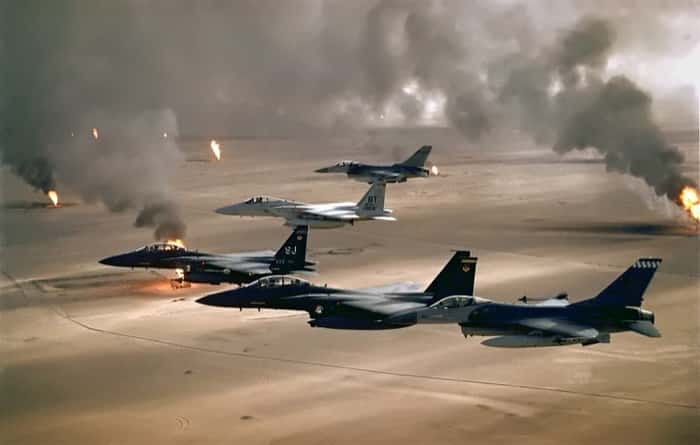
Under the codename Operation Desert Storm, the United States of America spearheaded a major military offensive targeting Iraqi forces. It all began on 2nd August 1990, when President Saddam Hussein ordered his military to invade Kuwait — a takeover that was fully complete within just two days. Iraq justified the aggression with claims that Kuwait had been engaging in slant oil drilling into Iraq's Rumaila oil fields and with a desire to wipe out the debt Iraq still owed Kuwait following the recently completed Iraq-Iran war.
The Iraqi government's unlawful seizure of Kuwait in 1990 triggered immediate and widespread international condemnation. In response, a powerful military coalition took shape, bringing together the United States and 42 other countries into one of the most formidable alliances the world had seen. The United Nations (UN) stepped in as well, demanding that Iraqi forces withdraw immediately and slapping heavy sanctions on the regime. Adding to the gravity of the moment, the then British Prime Minister, Margaret Thatcher, and the President of The United States, George Bush, moved quickly to deploy troops to Saudi Arabia and urged other nations to do the same — a decisive act that underscored both the scale and the historical importance of Operation Desert Storm.
What emerged was a military coalition of extraordinary strength — among the most significant assembled since World War II. The conflict played out across two distinct campaigns. First came a devastating aerial bombing effort that stretched across 42 consecutive days and nights, subjecting Iraqi forces to one of the most intense air force combats in history. During this phase, more than 100,000 sorties delivered about 85,500 tonnes of bombs, laying waste to both military and civil infrastructure. Then came the ground campaign — a ferocious artillery assault of about 90,000 rounds of fire over 2.5 hours that obliterated over 50 tanks belonging to Iraq's defense forces. Remarkably, the entire ground operation lasted less than 100 hours before Kuwait was fully liberated, a testament to the remarkable efficiency and success of the operation.
Peace terms were ultimately settled in 1991, with Iraq formally recognizing Kuwait's sovereignty and agreeing to divest itself of all weapons of mass destruction, at which point a ceasefire was declared. More than countries participated in Operation Desert Storm, and about 697,000 American troops took part in the battle.