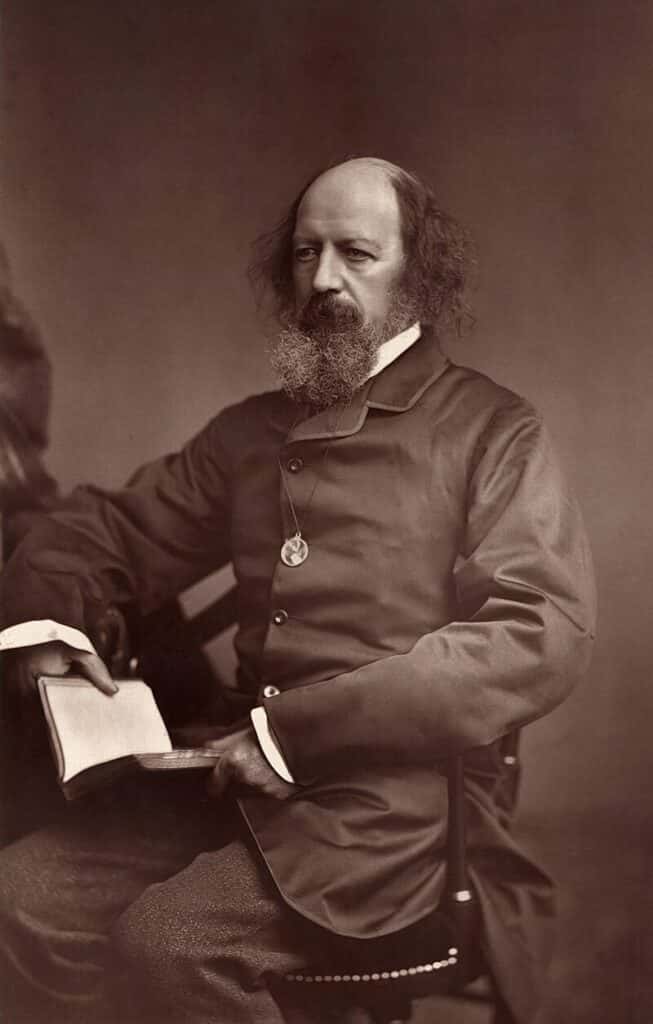
On August 6, 1809, in the sleepy village of Somersby, Lincolnshire, England, a baby entered the world who would go on to reshape the landscape of British poetry. Alfred Tennyson — later celebrated as Alfred, Lord Tennyson — arrived during an era marked by profound social and political turbulence. Remarkably, he shared his birth year with three other towering figures: Charles Darwin, Edgar Allan Poe, and Abraham Lincoln.
Growing up in a bustling household of twelve children, Alfred Tennyson experienced a childhood defined by both advantage and adversity. His poetic gift revealed itself early — he was already crafting verses by the age of eight, and by fourteen, he had produced an astonishing epic poem spanning 6,000 lines. At just 17, he and his brothers collaborated to publish a collection of his work. Yet it was at Trinity College that Tennyson truly came into his own as a poet. He became a member of the Cambridge Apostles, a prestigious intellectual circle that counted Arthur Henry Hallam among its ranks. Hallam would become Tennyson's dearest companion, and his devastating early death would later serve as the catalyst for some of Tennyson's most profound and enduring writing.
Rising to the Laureate
The year 1850 proved transformative for Tennyson on multiple fronts: he ascended to the role of Britain's Poet Laureate, stepping into the position vacated by William Wordsworth, and he wed Emily Sellwood, a woman he had loved since they were young.
No British poet held the laureateship longer — Tennyson served in the role for over 40 years, his words giving voice to the very soul of Victorian England.
- He wrote about war and heroism in "The Charge of the Light Brigade."
- He honored royalty and statesmen in public odes.
- He immortalized the myth in _"_Idylls of the King," a retelling of the Arthurian legend.
- He also wrote the works of "In Memoriam A.H.H.," and "The Charge of the Light Brigade," addressing topics ranging from scientific doubt and religious faith to imperial glory and personal loss.
Many of his lines became so iconic they wove themselves into the fabric of everyday speech:
- "To strive, to seek, to find, and not to yield."
- "'Tis better to have loved and lost than never to have loved at all."
When Alfred, Lord Tennyson, died in 1892, he was interred at Westminster Abbey — a national treasure mourned by millions.