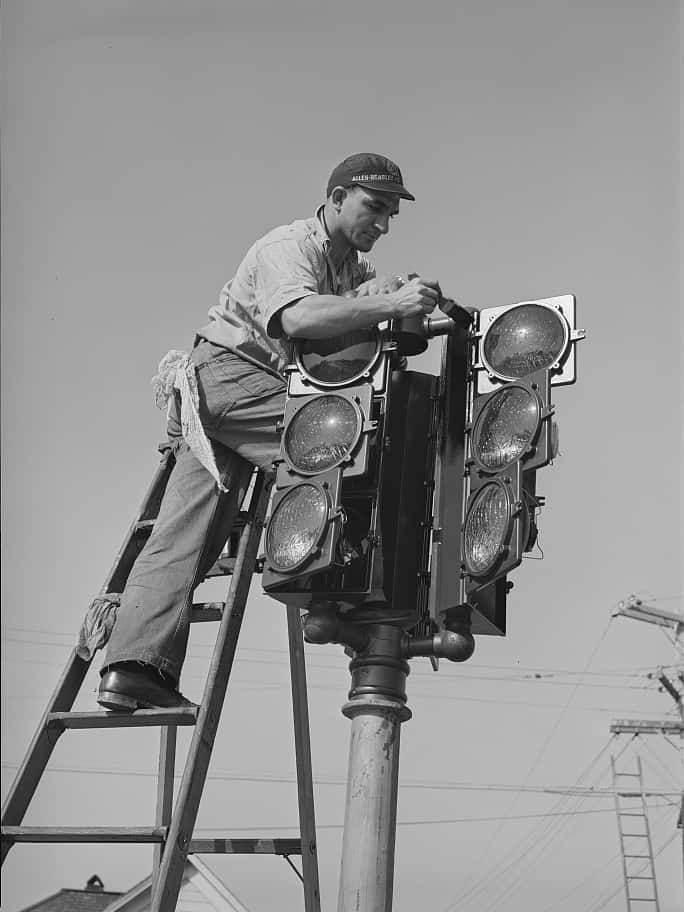
It was August 5, 1914, and something happened at the corner of East 105th Street and Euclid Avenue in Cleveland, Ohio, that would reshape urban life as we know it. The world's first electric traffic light blinked to life—a simple setup with a red light meaning stop and a green light meaning go—and traffic management was never the same again.
A Booming City with Chaotic Streets
Picture the chaos: horse-drawn wagons competing with streetcars, early automobiles weaving through crowds of pedestrians, all fighting for the same patch of road. Police officers planted themselves right in the thick of it, standing in the middle of intersections and putting their lives on the line just to keep things moving. The situation was dangerous, messy, and simply couldn't last.
That's where Safety Director Alfred Benesch and inventor James Hoge came in.
What Hoge developed—his "interlocking high reflector signals"—changed the game entirely. The design placed two lights, red and green, on poles at each of the intersection's four corners. The concept couldn't have been more straightforward, yet it was nothing short of revolutionary. Red meant stop. Green meant go. Bells sounded to signal which direction had the right of way, while a traffic officer sitting in a nearby booth operated the whole thing using switches.
And the location? That was no accident either. Euclid Avenue sat at the heart of Cleveland's East End shopping district. Benesch noted that more pedestrians passed through that particular corner than any other spot in the city—making it the ideal proving ground for such a daring experiment.
The Cleveland Automobile Club declared the trial "revolutionary." Business leaders, city officials, reporters, and even railway executives showed up to see the new system in action.
The Result
Once the signals were up and running, traffic flowed more safely and efficiently. Officers no longer had to stand in the danger zone. Pedestrians finally had a fighting chance at crossing the street.
After a year of operation, Benesch reported that the public was on board. Commute times dropped, accidents decreased, and Cleveland had found its groove. It wasn't long before other cities took notice and followed suit.
Yet this was only the starting point.
Within a few years, other inventors built on the idea and pushed it further. Garrett Morgan, a Black inventor from Cleveland, introduced a crucial third light—a warning signal. That yellow light was another breakthrough, carving out a pause between stop and go. It bought drivers precious moments to slow down and gave pedestrians extra time to make it across the street. Intersections became smarter and considerably safer.
What began as a single flicker at a Cleveland intersection grew into the automatic, multi-colored traffic signal systems we barely think twice about today.