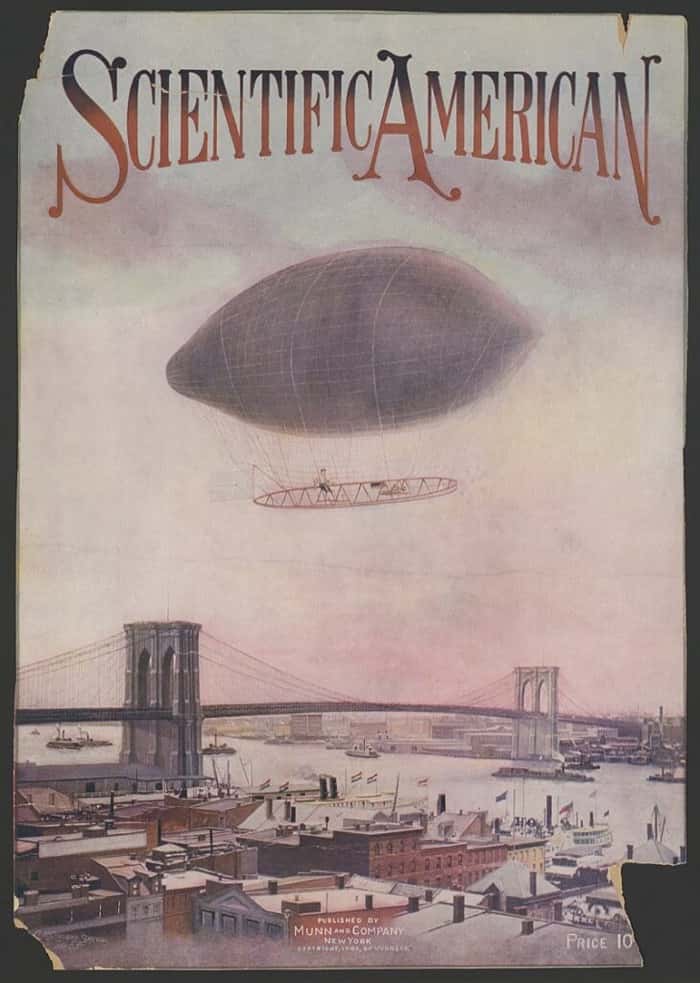
It all began on a Thursday morning — August 28, 1845 — when a modest, four-page publication hit the streets of New York City for the very first time. That publication was Scientific American, and though no one could have predicted it at the time, it would go on to become the oldest continuously published magazine in the United States. The man responsible for bringing it into the world was Rufus Porter, a figure so multifaceted that no single label could ever capture him.
Who Was Rufus Porter?
- Painter. Inventor. Dance instructor. Muralist. Poet.
- A true 19th-century Renaissance man.
- Before founding Scientific American, he experimented with several publications like the New York Mechanic and the American Mechanic.
Porter relocated his latest publishing endeavor to New York in 1845 and gave it a fresh identity. Scientific American came into existence, with its headquarters established at 11 Spruce Street. Editions were also produced in Boston and Philadelphia.
What Did the First Issue Entail?
What Porter envisioned went well beyond straightforward science reporting. Readers of his magazine could expect:
- Original engravings illustrating inventions and scientific principles.
- Essays on mechanics, chemistry, and architecture.
- Listings of American patents.
- News on innovations, both domestic and foreign.
- Music, poetry, and curious experiments.
Think of it as a hybrid — equal parts catalog, newspaper, and scientific journal. For a nation in the throes of industrial expansion, the timing couldn't have been better.
As it turned out, though, Porter himself wouldn't remain at the helm for long.
He parted ways with the magazine within a year, selling it to Alfred Ely Beach. The reason? Porter's restless mind was already chasing new obsessions — invention chief among them. And what followed was nothing short of extraordinary.
Porter the Inventor
Operating out of The Sun Building on Fulton Street, Porter churned out one creation after another:
- A wind-powered gristmill.
- An early washing machine.
- A cheese press.
- A life preserver.
- A rotary engine.
- Even an airship.
You read that right — an airship.
The concept was audacious: transport gold miners from New York to California in a mere three days, charging $200 per ticket. Small-scale test models actually worked, but scaling up to a full-size dirigible proved disastrous. A tornado wrecked his first hangar. A visitor accidentally ripped open the hydrogen bag. Subsequent attempts were dogged by malfunctions. One by one, investors walked away, and the ambitious dream collapsed.
The Legacy Continues
Porter's successor, Alfred Ely Beach, harbored grand ambitions of his own. He would go on to construct the Beach Pneumatic Transit — New York's first stab at an underground railway. This air-powered system ran beneath Broadway and, despite its brief existence, represented a genuinely revolutionary concept.
Beach also leveraged Scientific American as a platform to showcase his inventions and drum up public enthusiasm.
What started as a scrappy four-page pamphlet has since grown into a global publication reaching nearly half a million readers worldwide. The subject matter has broadened enormously over the decades, yet the core mission endures: an unwavering commitment to progress, invention, and curiosity.
From murals to dirigibles, from patent catalogs to the frontiers of planetary science, Scientific American has never ceased reinventing itself. It all traces back to one man's conviction that knowledge was meant to be shared freely — and to that Thursday morning of August 28, 1845.