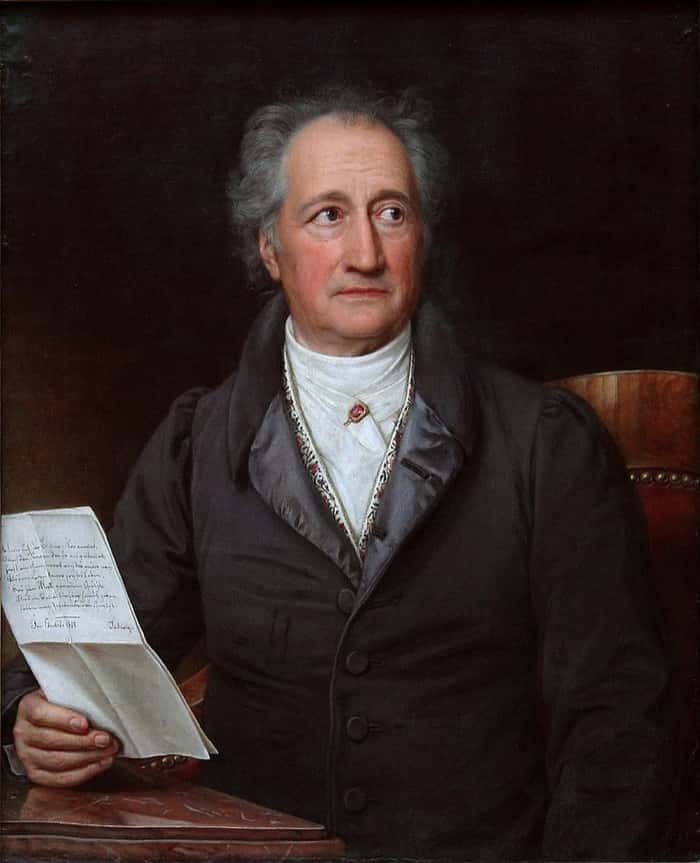
On August 28, 1749, in Frankfurt—then situated within the Holy Roman Empire—Johann Wolfgang von Goethe entered the world. From that moment, literature would never be the same. Goethe didn't merely contribute to the written word; he fundamentally transformed it. When death claimed him in 1832, he had already reshaped German culture from the ground up, made meaningful contributions to science, and set ablaze the imaginations of countless artists and intellectuals who followed. It all started in a prosperous middle-class home on Großer Hirschgraben, where the young Johann consumed books and languages voraciously, developed a deep love for the theater, and sat captivated by puppet shows put on by French soldiers.
A Life of Passion and Precision
Poet. Novelist. Playwright. Scientist. Statesman. Philosopher. Goethe embodied all of these roles—a true polymath driven by relentless curiosity. Though he pursued legal studies in Leipzig and Strasbourg, his soul was forever tethered to creative expression. Romance came to him frequently and with great intensity—his affairs with Anna Katharina Schönkopf and, later, Friederike Brion stand out in particular—and each left unmistakable reverberations throughout his literary output.
The Sorrows of Young Werther burst onto the scene in 1774, a novel of such fierce emotional intensity that it effectively lit the fuse of the Romantic movement. Readers devoured it instantly—but the book carried a dark shadow, triggering a wave of copycat suicides. With a single work, Goethe had set off a cultural earthquake powerful enough to define an entire era.
The Weimar Years: Genius Goes to Work
His rising celebrity drew him into the orbit of Duke Karl August in Weimar, where Goethe took on the mantle of statesman. He threw himself into reforming the local university, managed mining operations, and directed the court theater. A full decade of administrative service followed, yet his pen never fell silent. Works like Götz von Berlichingen, Egmont, Iphigenia in Tauris, and Torquato Tasso poured forth during this remarkably productive period.
Then, in 1794, a now-legendary bond formed between Goethe and Friedrich Schiller. These two towering figures of German letters pushed one another to greater heights, forging together the intellectual movement that became known as Weimar Classicism.
The Faustian Legacy
Six decades—that's how long Goethe labored over his magnum opus, Faust. The first part reached the public in 1808, while Part II only saw publication posthumously in 1832.
To this day, Faust looms over the landscape of European literature like a cathedral of thought. Comparisons to Paradise Lost and The Divine Comedy are not only inevitable—they're entirely deserved.
A Final Illumination
On March 22, 1832, Goethe breathed his last in Weimar. The final words attributed to him? "More light." Whether he was asking for sunlight or speaking metaphorically about enlightenment remains a point of debate. One thing, however, is beyond question: his life's work delivered both in abundance.