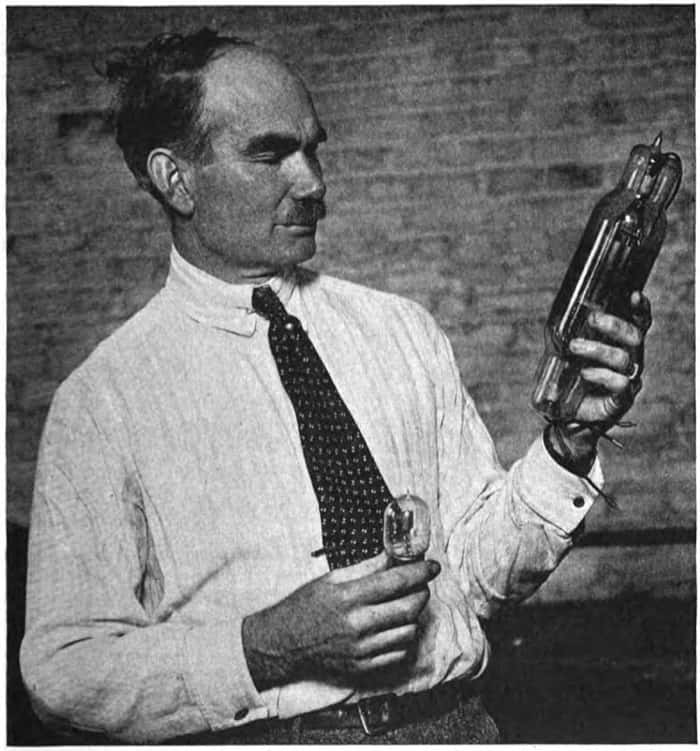
On this day, we mark the arrival into the world of someone whose contributions fundamentally shaped the dawn of the Electronic Age. Born on August 26, 1873, in a small town in Iowa, Lee de Forest would grow to become one of America's most influential inventors. Widely known as the "Father of the Radio," his groundbreaking work continues to resonate across the technological landscape to this day.
Impactful Inventions
- The Audion- a vacuum tube capable of amplifying both radio and electronic signals. Patented in 1908, this remarkable device made long-distance radio broadcasting not only possible but practical. Beyond radio, the Audion went on to become an essential building block in the earliest computers and television systems.
- The Phonofilm- an optical sound-on-film device designed to phonographically record an audio signal. De Forest secured a patent for this technology in 1920 and subsequently employed the system to produce phonofilm shorts that screened in theaters for several years. While Hollywood studios ultimately chose not to adopt this particular innovation, it nonetheless laid the groundwork and served as a blueprint for future breakthroughs in sound-on-film technology.
- Regenerative Circuit- a feedback loop engineered to amplify radio signals for reception. This invention, which received its patent in 1912, also proved instrumental in the creation of a more powerful radio transmitter.
While these three devices remain the most celebrated achievements of Lee de Forest, they represent just a fraction of his output — he patented over 300 inventions during his lifetime. His technological contributions earned him the distinguished titles "Father of Radio" and "Grandfather of Television." Recognition and accolades followed him throughout his career: the Institute of Radio Engineers bestowed upon him a "Medal of Honor," and he received the "Edison Medal" in 1946. The Motion Picture Academy also took notice, presenting him with an "Honorary Oscar" in acknowledgment of his pioneering work in bringing sound to motion pictures. Adding yet another distinction, he was honored with a star on the Hollywood Walk of Fame in 1960.
Legacy
The inventions of Lee de Forest are widely credited with ushering in the Electronic Age. He stands as a pivotal figure in the evolution of voice and sound across both wireless communications and motion pictures. Through his extensive body of work, de Forest cleared the path for countless modern technological advances, and his name endures as a symbol of vision, perseverance, and exceptional dedication.