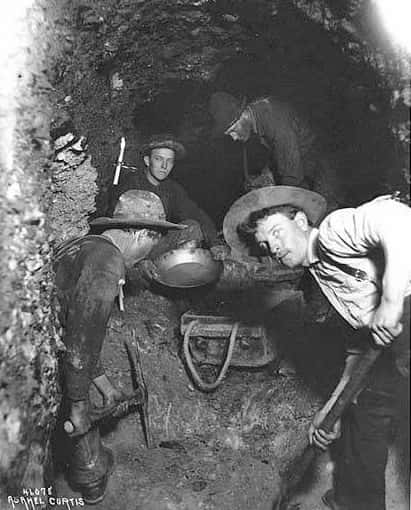
It all started on August 16, 1896, when gold was found for the first time in the Klondike region of Yukon, Canada. American George Carmack, along with Tagish First Nation members "Skookum" Jim Mason and Dawson Charlie, stumbled upon gold nuggets in Rabbit Creek (which would later be renamed Bonanza Creek). What followed was nothing short of extraordinary — their find sparked the Klondike Gold Rush, drawing thousands of fortune seekers to Yukon.
The official record credits Carmack as the discoverer, but historians continue to debate what really happened. There were rumors that Skookum Jim was actually the one who panned the creek. Members of Charlie's family later suggested that one of them spotted the glimmer first and brought it to Jim's attention. Concerned that the government might deny a claim filed by an Indigenous person, the group reportedly decided to let Carmack take the official credit.
A tip from Canadian prospector Robert Henderson — who himself has advocates arguing he deserved ownership of the claim — had guided the men in their search. In contrast to other gold-rich regions, prospectors in the Klondike freely exchanged information with one another. But the news didn't stay local for long. By the summer of 1897, newspapers had carried the story to the rest of the world, and their rapid reporting and broad circulation sent thousands of aspiring prospectors heading for Yukon.
Out of an estimated 100,000 migrants who set out, a mere 30,000-40,000 actually reached the Klondike. Almost none of them struck gold — those few who did build fortunes typically succeeded as entrepreneurs in the mining towns rather than as miners. Then, in 1899, when reports surfaced of gold being discovered in Nome, Alaska, prospectors packed up and left the Klondike to chase that new opportunity. Despite being short-lived, the Klondike Gold Rush left a deep and enduring mark on the region and its people, fundamentally reshaping both their lives and the surrounding landscape.