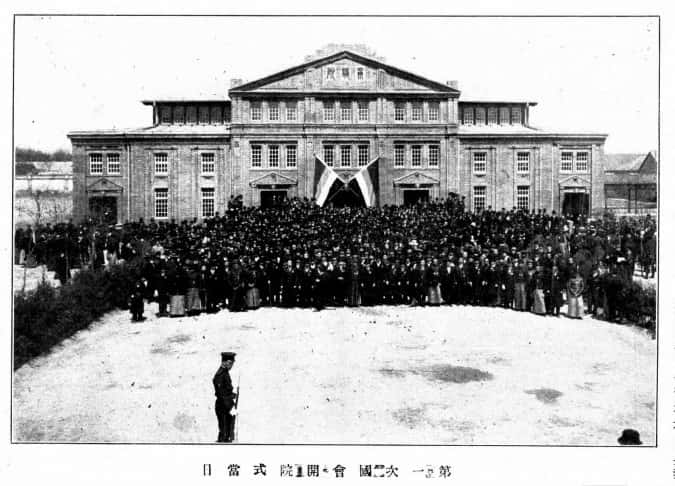
It was on April 8, 1913, that a truly historic event unfolded: China's first National Assembly convened in Beijing. Born from the ashes of the Qing Dynasty, which had collapsed just one year earlier, this legislative body represented an ambitious attempt to build constitutional governance for the fledgling Republic of China.
China had set itself a staggering challenge — dismantling an imperial system stretching back over two millennia and replacing it with a republican form of government. Central to this transformation was the Xinhai Revolution, the anti-imperial uprising that culminated in early 1912 when Puyi, the last Qing emperor, surrendered power. In the governing vacuum that followed, Sun Yat-sen stepped forward to lead the Kuomintang (KMT) Nationalist Party in founding the Provisional Government of the Republic of China. Meanwhile, Yuan Shikai assumed the presidency with the goal of preserving centralized government rule, adding yet another layer of complexity to this extraordinary political transition.
Newly elected representatives from every corner of China gathered in Beijing on April 8, 1913, for the assembly's inaugural session. At the heart of the body's mission lay two critical tasks: drafting a lasting constitution and serving as a check on presidential executive authority — functions essential to building a functioning parliamentary democracy. The Kuomintang achieved notable electoral success, with its members intent on leveraging the assembly's power to deepen democratic governance while curbing Yuan Shikai's executive reach. Yuan Shikai, however, backed by his grip on both the military and government finances, viewed the assembly as a direct threat to his position.
Yuan Shikai's resistance to the National Assembly stemmed from deep anxieties about losing his hold on power. These tensions intensified following the assassination of KMT leader Song Jiaoren in 1913. Moving decisively, Yuan Shikai shut down the legislative body and outlawed the KMT entirely, consolidating authority in his own hands. He went so far as to proclaim imperial rule in 1915 — a brazen violation of the very republican principles the assembly had been striving to uphold — though he was ultimately forced to abandon the throne before his death in 1916. This power grab dealt a severe blow to the young republic and laid bare the fierce struggle between democratic aspirations and authoritarian control that defined early republican China.
Though it proved short-lived, the 1913 Assembly occupies a vital place in Chinese history as the nation's inaugural experiment in constitutional governance. It became a critical arena where the deep-seated tensions between democratic ideals and centralized power were exposed for all to see. And while the assembly itself did not endure, the principles it championed left an enduring mark on both Taiwanese politics and Chinese reform movements — a testament to its profound role in shaping China's political trajectory.