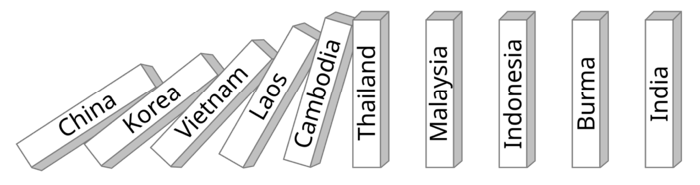
On April 7, 1954, the world got its first clear look at what would become one of the Cold War's most influential strategic concepts. During a press conference, President Dwight D. Eisenhower laid out what came to be known as the "Domino Theory" — the idea that if one nation succumbed to communist rule, its neighbors would inevitably follow suit, toppling one after another like a line of dominoes. This geopolitical framework would go on to serve as justification for American involvement in Vietnam and numerous other Cold War confrontations, while also drawing the lines for future containment efforts.
Tensions between the United States and the Soviet Union had been escalating throughout the early 1950s, fueling worldwide anxiety over the spread of communism. America's commitment to resisting communist advances was already on full display through the Korean War (1950–1953), and global attention was increasingly turning toward the unfolding crises in Indochina (Vietnam, Laos, and Cambodia). France had governed Indochina since the nineteenth century, but during that period, fighting intensified against communist forces under Ho Chi Minh and the Viet Minh. Alarmed that a communist victory in Vietnam could destabilize the entire region, the United States stepped in with both military assistance and financial backing for the French as the war escalated.
When a reporter asked President Eisenhower about Indochina's strategic significance at his April 7, 1954, press conference, he responded with what would become his most famous analogy. Picture a row of dominoes standing in a line, he explained. Knock over the first one, and you should immediately recognize that every remaining domino will come crashing down in rapid succession.
According to President Eisenhower, if Vietnam fell under communist control, a cascading effect would follow — potentially pulling Laos, Cambodia, Thailand, and an unknown number of additional nations into the communist orbit. With this stark warning, he cemented America's commitment to halting communist expansion, a principle that would steer national policy decisions across Southeast Asia for years to come.
What President Eisenhower delivered that day transcended a mere theoretical framework — it became a turning point in history. His words validated expanded American support for South Vietnam after France withdrew in 1954 and laid the groundwork for direct U.S. military intervention between 1965 and 1973. The ripple effects of the Domino Theory, which underpinned American containment policies, reached far beyond Southeast Asia, stretching from Latin America to distant corners of the globe.