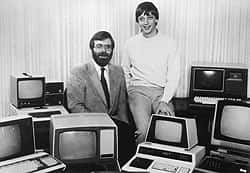
On April 4, 1975, two friends who had known each other since childhood — Bill Gates and Paul Allen — took a bold step that would ultimately reshape the entire technology landscape. Together, they launched Microsoft in Albuquerque, New Mexico, a modest software venture that would one day evolve into one of the most powerful tech companies on the planet.
The roots of their partnership stretched back years. Bill Gates and Paul Allen had bonded over a shared fascination with computers early in life, and that mutual interest drove them to establish a small enterprise called Traf-O-Data back in 1972. But the real turning point arrived in 1975, when the duo spotted an enormous opportunity in the emerging world of personal computing. They jumped at the chance to build software for the Altair 8800 microcomputer, crafting a BASIC interpreter and delivering a successful demonstration to MITS — a moment that effectively gave Microsoft its very first flagship product.
The company's original name was actually 'Micro-Soft', a fusion of the words 'microcomputer' and 'software', before being officially registered under the name Microsoft in 1976. Throughout this early chapter, Gates and Allen poured their energy into broadening the company's software portfolio. A key strategic decision came in 1979, when they relocated Microsoft's headquarters to Bellevue, Washington, planting the company firmly in the epicenter of the rapidly growing tech sector.
Microsoft's trajectory shifted dramatically during the 1980s. A landmark agreement with IBM in 1980 proved to be the catalyst — Microsoft would supply an operating system for the IBM Personal Computer. To fulfill this deal, the company acquired a CP/M clone known as 86-DOS, rebranded it as MS-DOS, and licensed it to IBM. This shrewd maneuver propelled Microsoft toward its commanding position in the PC software market and stands as one of the most consequential turning points in the company's story.
Then came 1985, a landmark year for personal computing. Microsoft unveiled Windows 1.0, introducing a groundbreaking graphical user interface to the masses. It was an innovation destined to transform how people interacted with their computers, and over the following decades, Windows would rise to become the most widely used operating system in the world.