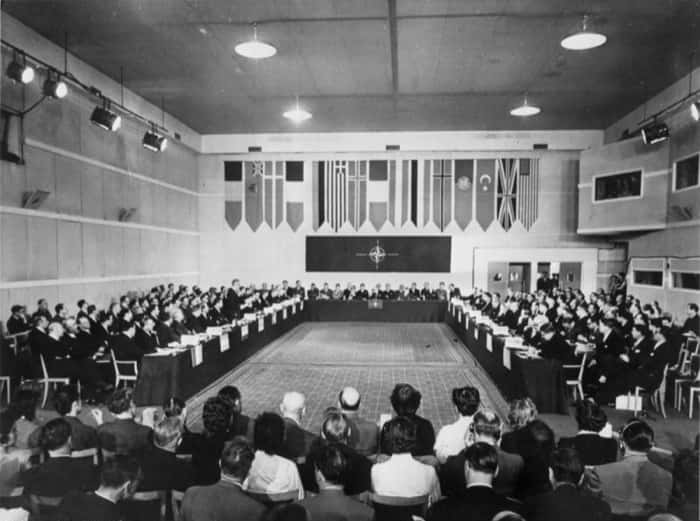
On April 4, 1949, a dozen countries came together to sign the North Atlantic Treaty in what would become one of the most consequential diplomatic acts of the twentieth century. With that signature, the North Atlantic Treaty Organization (NATO) was officially born—a military alliance forged with the express purpose of safeguarding security and stability in the face of mounting Soviet influence as the Cold War took shape.
World War II had left Europe in ruins. The Allied nations may have succeeded in bringing down Nazi Germany, but peace proved elusive. A different kind of confrontation was already brewing—the Cold War. Under the leadership of Joseph Stalin, the Soviet Union was steadily tightening its grip on Eastern Europe, propping up communist regimes across the region. This growing divide gave rise to what became known as the Iron Curtain, both a symbolic and tangible barrier separating the Soviet-controlled Eastern Bloc from the democratic nations of the West.
The prospect of continued Soviet expansion deeply alarmed Western powers. The United States, the United Kingdom, and France were especially wary, with the United States—now a global superpower—viewing the spread of communism as a direct threat. It became increasingly clear that a collective approach to security was essential. The solution? A formal alliance capable of deterring Soviet aggression while reinforcing political stability across the region. That vision materialized on April 4, 1949, when the North Atlantic Treaty was signed in Washington, D.C.
The original 12 member countries were:
- United States
- Canada
- United Kingdom
- France
- Belgium
- Netherlands
- Luxembourg
- Norway
- Denmark
- Iceland
- Italy
- Portugal
Central to the entire framework of NATO was Article 5—a powerful declaration establishing that an armed attack against any single member would be treated as an attack against them all. This collective defense principle served a clear purpose: discourage aggression before it started and present a unified front in the face of any threat.
Once established, NATO rapidly evolved into the cornerstone of Western defense throughout the Cold War era. Its membership steadily grew over the decades, expanding well beyond the original 12 signatories to reach 31 nations today.
Some historical moments:
- 1952: Greece and Turkey join NATO.
- 1955: West Germany becomes a member, prompting the Soviet Union to form the Warsaw Pact.
- 1999–Present: Former Soviet-aligned nations, including Poland, the Baltic states, and others, join NATO, reaffirming its role in European security.