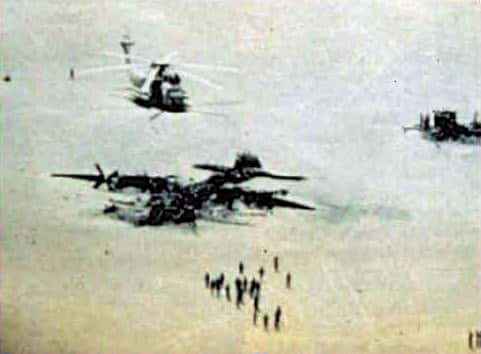
On April 24, 1980, Operation Eagle Claw launched as an audacious American effort to rescue U.S. hostages imprisoned in Iran — but it ended in disaster deep in the Iranian desert. A haboob, a fierce sandstorm, had already created delays and severely limited visibility when the unthinkable happened: a helicopter and a transport jet slammed into each other. Eight servicemen — 5 Air Force and 3 Marines — lost their lives, and the entire mission had to be scrapped.
The plan itself was breathtakingly bold. A team of elite U.S. special forces, comprising Army Rangers and Delta Force commandos, would fly covertly into Iran under cover of darkness, rendezvous at a secluded desert staging area dubbed "Desert One," then push on to Tehran the following night to storm the embassy and extract the hostages. But things fell apart before the rescue phase even began. Of the eight helicopters sent to Desert One, only five made it there in working condition — one succumbed to a dust storm, while another turned back due to mechanical failure. Faced with insufficient aircraft, commanders took the agonizing decision to call off the operation. Then, during refueling procedures as forces prepared for departure, a helicopter inadvertently collided with a stationary C-130 transport jet. The resulting explosion was devastating, claiming the lives of eight American servicemen and leaving numerous others wounded.
Americans reacted with fury to what became both a military and political humiliation, one that laid bare serious flaws in how special operations were coordinated and commanded across service branches. President Jimmy Carter shouldered complete responsibility for the debacle, and it dealt a significant blow to his reelection prospects. Yet Eagle Claw proved to be far more than just a failure — it became a catalyst for transformation. The U.S. military undertook a sweeping reorganization of its special operations forces in the aftermath. Born directly from the logistical and coordination breakdowns of that fateful night, the 160th Special Operations Aviation Regiment was created to deliver specialized air support for missions of this nature. Additionally, the United States Special Operations Command (USSOCOM) came into existence to unify oversight and coordination of all special operations forces. Together, these reforms dramatically enhanced the military's capacity to carry out complex, high-stakes operations.
For all its heartbreak, Operation Eagle Claw ultimately became a profound catalyst for change. The failures and deficiencies exposed by the mission laid the groundwork for future triumphs. Consider the 2011 raid that killed Osama bin Laden — carried out with exactly the kind of seamless coordination and pinpoint precision that had been so conspicuously absent during Eagle Claw. That evolution stands as testament to the hard lessons absorbed and the sweeping improvements forged within the U.S. military.