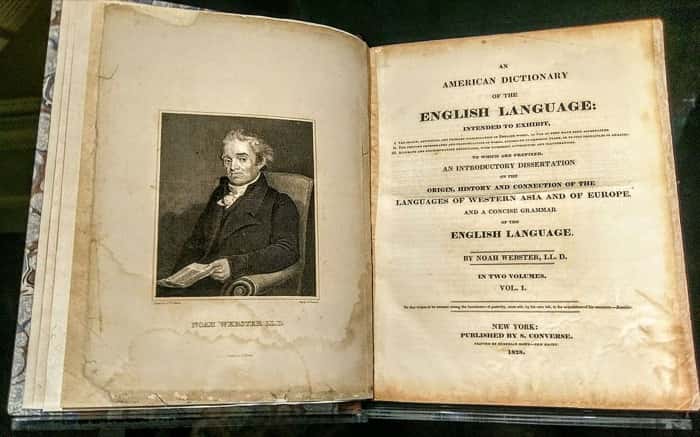
It's hard to imagine now, but there was once a time when the English language was even more bewildering than it already is. Without a dictionary to serve as a shared reference point, people of varying backgrounds constantly clashed over something as basic as how to spell or pronounce a word. That all began to change on this landmark day in 1828, when Noah Webster introduced his An American Dictionary of the English Language to the world. Far more than a simple word list, this groundbreaking volume carved out a clear distinction between American English and its British roots, reshaping American culture in profound ways. The painstaking work Webster poured into this project still echoes through the way Americans spell, pronounce, and understand their language today.
Noah Webster transformed America's relationship with language forever on this day in 1828. His An American Dictionary of the English Language — the first dictionary of its kind actually written on American soil — hit the shelves and made an immediate statement. Packed with approximately 70,000 words, a remarkable number of which had never been formally documented before, the volume stood as a monument to Webster's deep commitment to the American language. He had carefully compiled definitions while reshaping spelling, pronunciation, and grammar to mirror a distinctly American character.
What set Webster's dictionary apart from British reference works of the era went far beyond vocabulary — it was a vehicle for championing a uniquely American culture. His deliberate spelling reforms, like choosing 'color' instead of 'colour' and 'theater' rather than 'theatre,' carried weight well beyond mere preference. These changes amounted to a defiant declaration of linguistic independence from British conventions. At the core of Webster's vision was a conviction that language held the power to unite a fledgling nation.
This monumental achievement was the culmination of more than two decades of effort. Webster laid the groundwork with spelling books, grammars, and readers that became essential fixtures in early American classrooms. When the dictionary at last made its debut, it was hailed as both a scholarly triumph and an act of patriotism. Although the first edition fell short of the sales Webster had envisioned, subsequent versions gained widespread acceptance, and the dictionary's reach only expanded over time. His enduring legacy thrives today through the well-known Merriam-Webster Dictionary.
Fun Facts:
- It took Webster nearly 27 years to complete the dictionary.
- Noah Webster was a Connecticut House of Representatives member from 1802 to 1807.
- He learned 26 languages to understand word origins better.
- Webster included uniquely American words, like "skunk" and "squash."
- Modern American English spelling still follows many of his recommendations.