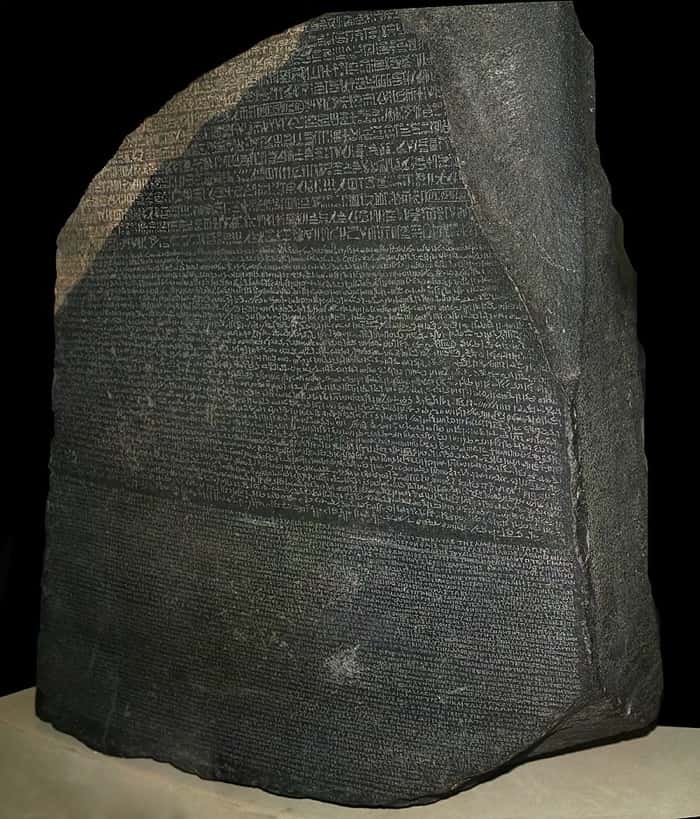
On July 15, 1799, the Rosetta Stone was found, unlocking the secrets of ancient Egyptian hieroglyphs.
Picture stumbling across an artifact that could decode an entire civilization's forgotten language — the thrill would be indescribable. Yet that's precisely what unfolded on July 15, 1799, near the small Egyptian town of Rosetta.
French troops stationed in the area had been working to strengthen Rosetta's defenses. During this effort, officer Pierre François Xavier Bouchard made a discovery far more remarkable than any military fortification — the Rosetta Stone.
It was no ordinary piece of rock.
Carved from black basalt, this hefty slab was roughly the dimensions of a large coffee table — about 44 inches (1.12 meters) tall, 30 inches (76.2 cm) wide, and 11 inches (27.94 cm) thick. Tipping the scales at approximately 760 kilograms (1,680 lb), its surface bore a single message rendered in three distinct scripts: the elaborate symbols of hieroglyphs, the more accessible Demotic script, and Ancient Greek, which scholars already understood well.
Within those parallel inscriptions lay the potential to solve a puzzle that had eluded historians for centuries: how to read Egyptian hieroglyphs.
Think of it as the ultimate cheat sheet for decoding an ancient language.
Deciphering the stone, however, was anything but swift. It demanded years of meticulous effort from brilliant scholars, none more pivotal than Jean-François Champollion. His breakthrough finally came in 1822, the result of exhaustive comparisons between symbols across the three scripts.
Champollion recognized the names of Ptolemaic kings rendered in both hieroglyphs and Greek, which enabled him to map phonetic values onto certain hieroglyphic symbols.
That single breakthrough flung wide the gates to Ancient Egypt. Slowly, hieroglyphs surrendered their meaning — revealing tales etched into temple walls, royal decrees issued by pharaohs, and glimpses into the everyday existence of ordinary Egyptians.
To this day, the Rosetta Stone stands as one of archaeology's most consequential discoveries. Visitors from across the globe continue to marvel at it within the British Museum, where it remains a source of endless fascination and learning.