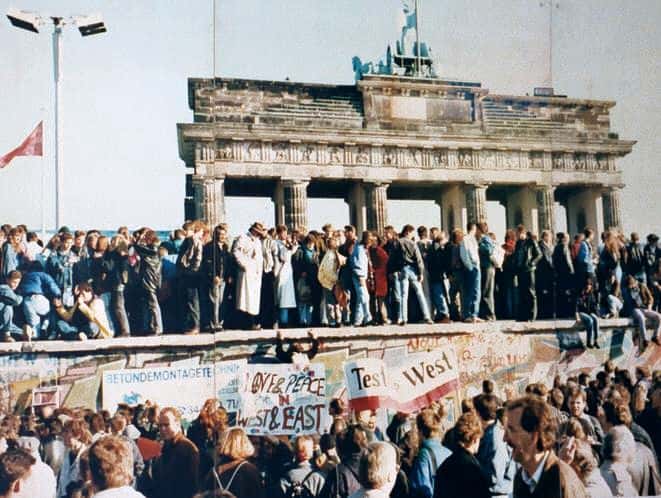
What comes to mind when you think of the Cold War? For many, it's the Berlin Wall — a physical manifestation of an otherwise largely invisible global conflict. This jagged scar had sliced through Berlin for decades before officials embarked on the momentous work of dismantling it on November 10, 1989. The East German government found itself powerless to stop what was happening — citizens from both sides were already using sheer human strength to tear the barrier apart. Today, the wall exists mainly as a fading memory for most Germans, preserved through a museum and a memorial honoring the thousands who lost their lives attempting to scale the wall to reach West Berlin.
Construction of the Berlin Wall began in 1961, driven by the East German Government's desire to halt the steady flow of people emigrating from East Germany to West Germany. Ever since World War Two ended, Communist rule had prevailed across Eastern Bloc countries under the Soviet Union's heavy-handed influence. From 1945 to 1961, escaping these nations was as straightforward as crossing the border separating East and West Berlin. This accessibility triggered a devastating brain drain, as doctors, engineers, and other skilled professionals fled westward.
But the East Germans went far beyond simply erecting a wall. Elevated guard towers loomed over the barrier, manned by sentries who surveilled it with the vigilance of prison guards. On the far side stretched a "no man's land," where East German soldiers fired upon anything and anyone in sight. Over the years between 1961 and 1989, 140 people perished in attempts to cross, with more than a hundred of those victims gunned down while running through no man's land. Fully imprisoning the residents of East Berlin was a process that took roughly a year to complete.
Looking back, the Berlin Wall stands as an enduring symbol of the failure of both the Soviet Union and East German governments. Yet it would be a mistake to suggest the wall simply came down in a sudden burst over a few days. Throughout the eighties, Eastern Bloc countries such as Poland had been steadily pushing back against Soviet control. The dramatic day when the world realized the wall was coming down was really just the culmination of a years-long struggle to reverse what the Soviet Union had imposed on Eastern Bloc countries.