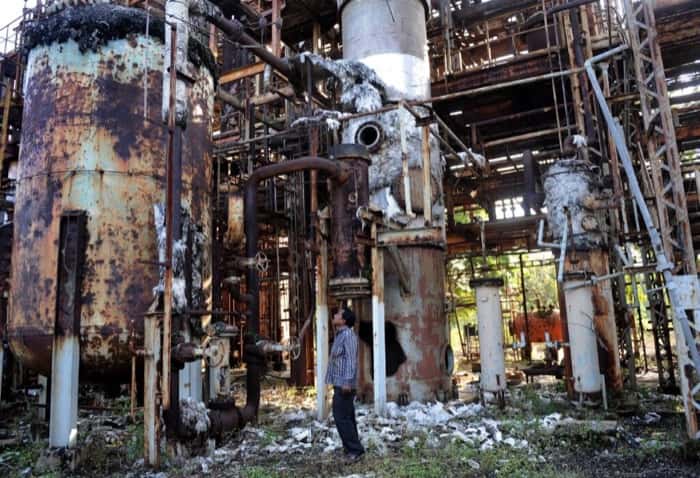
The gas explosion in Bhopal, India stands as the most catastrophic human-caused environmental disaster in recorded history.
Union Carbide India Limited (UCIL)
Back in 1969, Union Carbide India Limited (UCIL) constructed a pesticide facility aimed at supporting farmers who were struggling with devastating crop failures. In the post-World War Two era, global population growth had surged dramatically, and terms like "world hunger" had become a fixture of evening news coverage. By producing essential pesticides to help farmers fight off pests — while simultaneously creating employment opportunities for people in the surrounding community — the UCIL plant addressed a real and pressing need. Tragically, though, the facility was plagued by insufficient safety protocols, and gas leaks happened with alarming regularity.
The Deadly Leak
What began as a minor gas leak on December 2, 1984 rapidly escalated into a catastrophic explosion, releasing over 40 metric tons of methyl isocyanate (MIC) gas into the surrounding area. Despite MIC being extremely toxic to humans, only the most minimal safety precautions had been implemented since production was scaled up in 1979. It was during that same year that the Bhopal UCIL plant had added an online MIC production facility designed to keep pace with growing fertilizer demands.
In the aftermath, official records documented 2,259 deaths alongside 500,000 injuries. Pinpointing the true toll, however, remains difficult, as the poisonous gas cloud drifted across several kilometers.
What About A Safety Team?
While the new MIC facility did have managers and operators in place, oversight looked nothing like what you'd find at American-supported companies operating under OSHA's watchful eye. By 1984, the Indian government held partial ownership of the Indian UCIL plant and bore responsibility for safety oversight. The practical outcome was a pesticide manufacturing operation functioning with virtually no OSHA-equivalent accountability structure. As a consequence, the plant posed a lethal risk from poisonous gas exposure to everyone working inside it and living nearby.