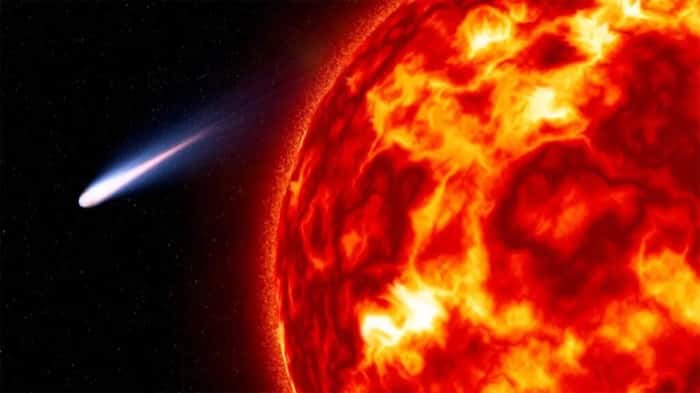
Our planet shares its cosmic neighborhood with countless mysterious objects in perpetual motion around the Earth, Sun, and Moon. To track these objects and document any collisions that take place, scientists rely on instruments deployed into space. These instruments follow carefully calibrated orbits around the Earth, maintaining precise speeds and distances relative to one another. On August 30, 1979, one such instrument captured something extraordinary: a comet slamming directly into the Sun, unleashing massive energy waves in the process. How powerful were those waves? They packed the punch of 1 million hydrogen bombs.
This landmark event — the collision of the Comet Koomen Michels (formerly known as C/1979 Q1) with the Sun — was recorded by a coronagraph aboard the satellite P78-1, commonly referred to as Solwind.
Fun Facts:
- A coronagraph is a telescopic attachment designed to filter excess white light from a star so the human eye can make out events unraveling during extreme solar blasts.
- A sun-grazing comet isn't one that actually touches the sun. Rather, it's defined by a comet that gets within a few thousand kilometers of the sun's surface.
- Aristotle is believed to have seen a sun-grazing comet.
- Solwind was launched on Atlas F on February 24, 1979, from the Vandenberg Space Force Base.
- Solwind was operational for 5 years. Its greatest contribution was capturing this comet. After it was discovered, scientists were able to pinpoint a number of other comets and asteroids.
- SOLWIND was destroyed in 1985 by a ground-based missile during a planned Air Force exercise.