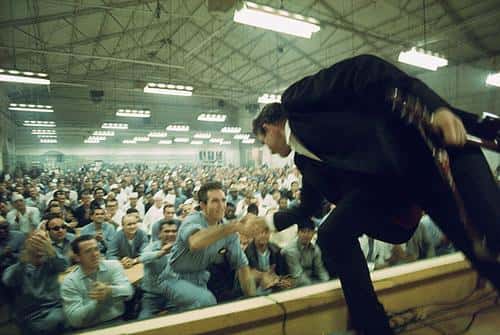
By the late 1960s — and certainly by the time his landmark live album Johnny Cash at San Quentin (1969) was recorded — Cash had firmly established himself as an outsider within the music industry. He connected with convicts on a level that most musicians simply couldn't match, crafting a sound that resonated with inmates in prisons across the U.S. Though Cash himself never spent more than a few overnight stays behind bars, those brief brushes with jail were enough to convince him that a life of crime wasn't for him.
Johnny Cash Plays At San Quentin
On January 1, 1960, when Cash took the stage at San Quentin for the very first time, a future country music recording legend named Merle Haggard was sitting in the audience as an inmate. Just 19 years old at the time, Haggard was serving a sentence for armed robbery. He would later credit Cash with steering him away from a criminal path and toward a life in music — and from there, the story became country music legend.
Not long after that performance, Johnny Cash found himself back in the states and earning airplay with "Folsom Prison Blues." The track was Cash's second hit single, originally released in 1955.
Cash's Passion for Reform
Throughout his career, Johnny Cash continued performing free concerts for prison populations. His commitment to the cause went beyond music — in 1972, he testified before Congress advocating for prison reform. The idea that even criminals deserved a shot at redemption was something Cash believed in wholeheartedly.
Cash's fascination with life behind prison walls reportedly traces back to 1951, when he was stationed in West Germany as part of the U.S. Air Force Security Service. There, he watched a film called Inside the Walls of Folsom Prison, a fictional account of a ruthless inmate navigating the brutal conditions of pre-reformed Folsom Prison. Before California prison reform took place in 1944, Folsom had earned a grim reputation for the harsh torture inflicted on its inmates.
.