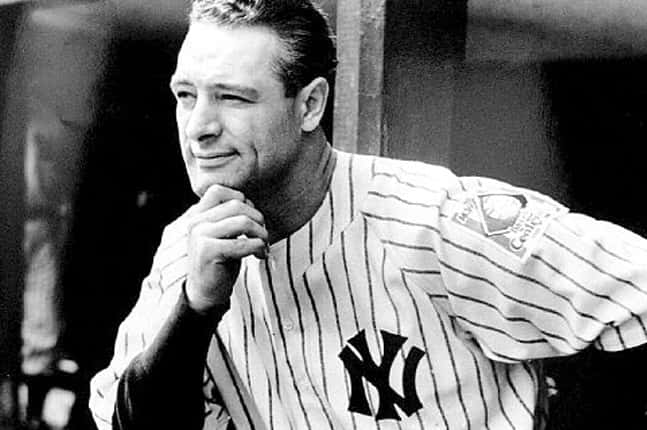
It's hard to overstate just how central major league baseball was to the fabric of American life throughout the Great Depression. So when America learned that Lou Gehrig had been inducted into the National Baseball Hall of Fame on December 7, 1939, the nation came together to honor a hero whose light was fading far too soon.
Only months before, on June 12, Gehrig had suited up for the last time as a New York Yankee during an exhibition game in Kansas City. Fans packed the stadium well beyond its 17,500 capacity, filling every inch of standing-room-only space just to watch him take his familiar position at first base one final time. Tragically, amyotrophic lateral sclerosis (ALS) – now known as Lou Gehrig's Disease – would claim his life just two years later at the age of 37.
Background
Gehrig came into the world on June 19, 1903, and was the sole survivor among his parents' five children to reach adulthood. His family were German immigrants who had arrived in New York City near the close of the 19th century. While playing baseball for his local Manhattan high school team, the young Gehrig caught the eye of a Major League scout from the Yankees, who recognized his remarkable talent for hitting home runs. At just 19, he stepped onto the field for his first major league baseball game wearing Yankee pinstripes. From 1923 to 1939, he spent 17 seasons anchoring first base for the Yankees.
Gehrig's Legacy
Known by the nickname "Iron Horse," Gehrig earned that moniker through his powerful hitting and remarkably consistent excellence on the diamond. Over the course of his career, he compiled a .340 batting average and launched 493 home runs, contributing to six championship teams. What made Gehrig more than just a sports celebrity — what elevated him to the status of an enduring American hero — was the role he played as a reliable source of joy during the bleakest years of the depression. For fans whose daily lives were defined by hardship, he was a constant bright spot. That's why his final game meant so much: it gave those fans one last opportunity to watch their hero play ball and to remember a time when life felt simpler and bread didn't cost so much.