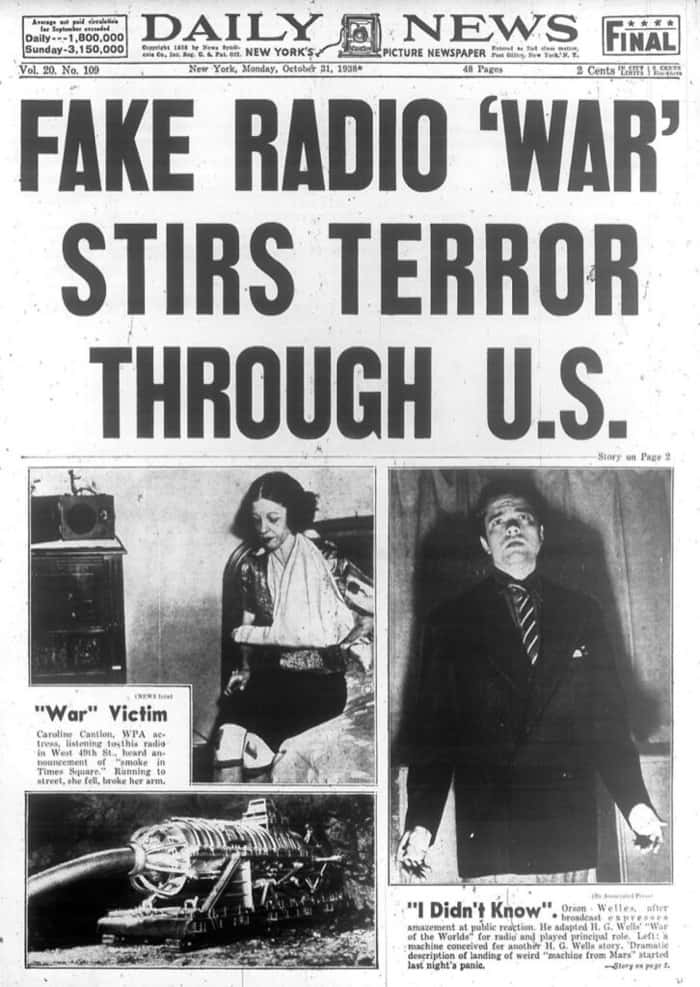
By October 30, 1938, Orson Welles — the multitalented American actor, director, screenwriter, and producer — was no stranger to the airwaves. Radio broadcasting was already well-trodden ground for him, and he had built a considerable reputation through on-air adaptations of beloved literary works, among them a 7-week series on Les Miserables. Many considered him a creative genius, and his name had become synonymous with fame and greatness.
The War of the World Broadcast
That night, though, the 23-year-old wunderkind ventured beyond the boundaries of creative convention — perhaps a step too far. Without any prior announcement, Welles launched into an adaptation of H.G. Wells's 1897 book, The War of the Worlds, during his live slot on The Mercury Theatre. What made this particular production so unforgettable was its strikingly realistic news-style format, complete with between-breaks dial spinning that blurred the line between fiction and reality.
In an era with no means of fact-checking, radio listeners took what they heard at face value — and the consequences were staggering. Police stations were flooded with an unprecedented volume of phone calls, there were suicides, and threats soon followed. By Halloween morning, Orson Welles's face dominated the news cycle, splashed alongside coverage of the fake broadcast and the wave of panic it had unleashed. In the years that followed, Welles gave numerous interviews in which he alternately pleaded innocence and, at times, hinted that he knew exactly what he was doing.
After the Broadcast
The fallout from the broadcast paradoxically catapulted Orson Welles to even greater fame, and Hollywood soon came knocking with offers. Though he initially turned them down, preferring to stick with radio, Welles ultimately made the leap to the big screen. His filmography came to include a number of notable pictures: Citizen Kane, The Magnificent Ambersons, Journey into Fear, The Lady from Shanghai, The Stranger, and a 1948 adaptation of Macbeth.
His personal life proved equally eventful, marked by a string of marriages and divorces. Welles kept working right up until his death on October 10, 1985, at the age of 70.