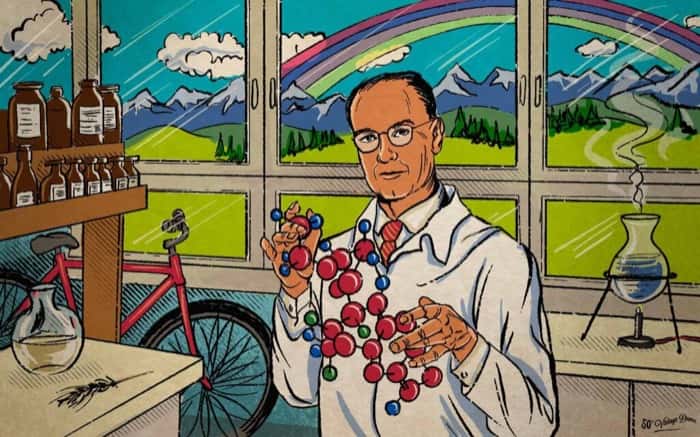
It was November 16th, 1938, when Dr. Albert Hofmann, a Swiss chemist, first synthesized LSD — a moment that would reshape conversations about consciousness for decades to come. As Hofmann himself famously put it, "I did not find LSD, LSD found me," a quote that speaks volumes about just how accidental and unassuming the whole discovery really was.
A specialist in plant science, Hofmann spent his career analyzing various plant samples, working to purify and synthesize their active components for use in pharmaceuticals. It was during his research with ergot — a fungus that occurs naturally on rye and other grains — that he stumbled upon the hallucinogenic compound.
The First LSD Trip
Interestingly, although LSD was first discovered back in 1938, Dr. Hoffman wouldn't actually experience its psychedelic effects until 1943.
While synthesizing a fresh batch of LCD-25, Dr. Hofmann inadvertently absorbed some micrograms of the substance through his fingers. The experience left a vivid impression — he later characterized it as "extraordinary shapes with intense, kaleidoscopic play of colors."
Then, on April 19, 1943, just a few days later, Hofmann deliberately ingested LCD-25 again — this time upping the dose to 250 micrograms with his assistant standing by to supervise. He reported a range of effects: dizziness, anxiety, and an urge to laugh.
What stands out from this particular trip is Dr. Hofmann's observation that his peak high occurred between 6 and 8 pm — a window during which he made his now-legendary bicycle ride home.
Fun Facts:
- April 19 is deemed "Bicycle Day" in honor of Dr. Hoffman's iconic bicycle ride home.
- During the Cold War, the CIA ran experiments using LSD as a potential tool for mind-controlling interrogation.
- The effects of LSD are unpredictable. While some may experience a "good trip," others may have a negative experience and even suffer fatal accidents.
- Among the long-term side effects associated with LSD are schizophrenia and severe depression.