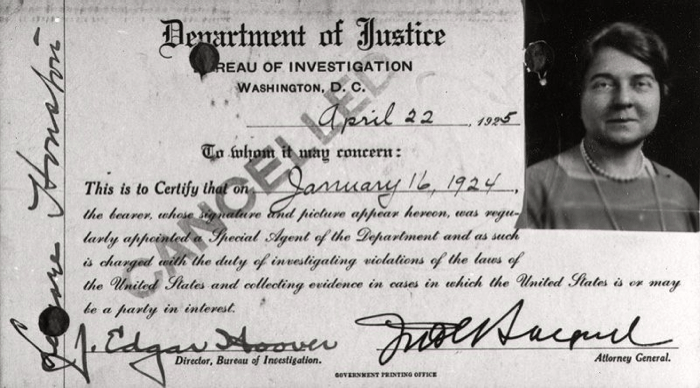
When we think of trailblazers in federal law enforcement, the name Alaska Davidson deserves a prominent place. On October 11, 1922, Davidson made history by becoming the very first woman to serve as a special investigator in the FBI — she was 54 years old at the time. Women had been part of the FBI workforce before, but none had ever held the specific role of special investigator. Sadly, her groundbreaking tenure proved short-lived. Just two years after her appointment, J. Edgar Hoover stepped in as director and pushed her out of the position. It would take until 1972, not long after Hoover's death, before women would once again serve in this capacity within the FBI.
Davidson's Background
The historical record offers frustratingly few details about Alaska Davidson's life. What we do know is that she was born in 1868 in Ohio. According to available records, her formal education was limited to only three years of public schooling, and she never went on to pursue any higher education.
In 1893, she married Ephraim B. McCrum Jr., and together they had a daughter, Esther, who tragically passed away in 1902. The marriage itself didn't endure much longer either — both the 1910 and 1920 census records list her as the wife of a different man, James B. Davidson. He eventually passed away as well, and by the time the 1930 census was taken, Davidson was recorded as a widow.
Work in the FBI
The FBI hadn't previously employed women as special investigators, but cases involving the Mann Act prompted the bureau to consider whether female agents might prove useful in that area. Davidson, however, was described as "very refined," which made her seem like a poor match for investigations dealing with crude interstate sex trafficking.
Instead, she received an assignment at the Washington D.C. office, where her starting pay was $7 a day, supplemented by an additional $4 per day whenever she traveled.
Hoover Takes Office
Davidson's minimal formal education combined with her limited involvement in active cases left her particularly vulnerable when budget and staffing reviews came around. Upon taking the reins as director, Hoover directed every office to scrutinize their personnel and dismiss anyone deemed unqualified. The agent overseeing Alaska's office reported back to Hoover that there was simply no work available for a female agent, and on June 10, 1924, she was asked to resign.
It wasn't until after 1972, following the passage of the Equal Employment Opportunity Act, that women were once again given the chance to serve in special investigations at the FBI.