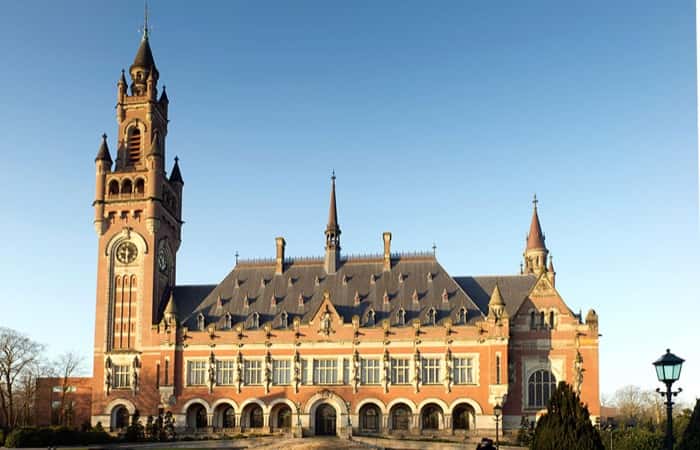
The idea of a worldwide tribunal with the authority to impose consequences on sovereign nations is a concept that has existed for just over a hundred years. As the nineteenth century drew to a close, the most powerful nations on earth had planted colonial flags across the globe. This expansion brought with it the challenge of governing far-flung populations — governance that sometimes erupted into armed conflict, particularly over control of surrounding seas. Wars grew more frequent as emerging powers clashed with local populations who rejected foreign domination. By 1900, conversations had begun about how to hold aggressive nations accountable for their actions.
Prior to the establishment of an International Court of Justice, there was simply no mechanism for ensuring that countries faced consequences for the decisions made by their leaders. But a pressing question loomed: who would oversee such a court? Without an international body like the U.N. to lend legitimacy, the idea struggled to gain traction — especially since nations like the United States preferred to remain uninvolved in the conflict. Everything shifted, however, when the Great War (known posthumously as World War One) erupted across Europe in 1914.
When the U.S. finally joined the fighting in 1917, combat had ground to a halt along a sprawling western front. World One was nearing its conclusion, and the allied powers recognized the need for a framework to hold Germany responsible. At the same time, President Wilson championed the creation of an international organization that could serve as the foundation for a global court — motivated in part by the desire to punish Germany. Out of this push, the League of Nations emerged as a component of the Treaty ending the war. President Wilson's blueprint for lasting peace, laid out in his Fourteen Points speech, gave rise to the League of Nations. Then, on December 13, 1920, The League of Nations brought the International Court of Justice into existence in The Hague.