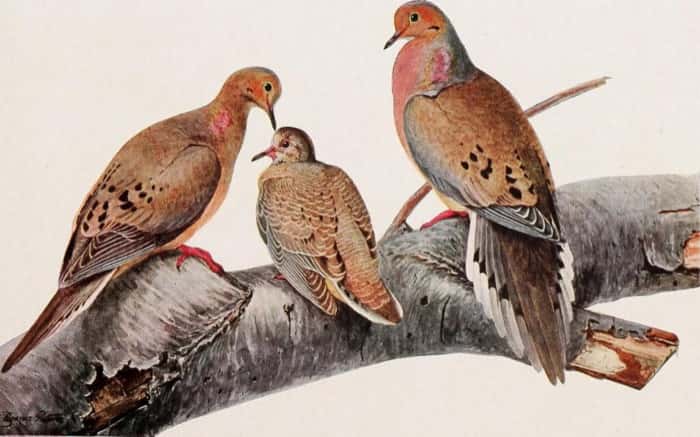
The world's final Passenger Pigeon was a bird named Martha, and her origins are the subject of some debate. One account suggests she was part of a flock kept by Professor Charles Otis Whitman at the University of Chicago. Another holds that Martha was hatched right there at the zoo as a way to showcase native wildlife for the community. Then there's the more straightforward explanation—that she was simply a zoo purchase. However Martha ended up at the Cincinnati Zoo, her story marks both a life and a loss worth remembering: the end of an entire species.
When Martha passed away at the Cincinnati Zoo on September 1, 1914, the Passenger Pigeon officially joined the ranks of extinct migratory birds.
Quick Facts:
At the time of her death, Martha was in the middle of molting, which meant she was missing a number of feathers.
She was reportedly named after Martha Washington.
Passenger Pigeons kept in captivity commonly reached ages of about 15 years. By all reports, Martha was 28 when she died.
In a bitter twist of irony, natural predators were not a major factor in the Passenger Pigeon's disappearance. What actually drove the species toward extinction was excessive exploitation by humans, which shrank the population to the point where it became vulnerable to collapse.
By 1907, only three Passenger Pigeons remained—two males and Martha. One male died in 1909, followed by the other in 1910, leaving Martha completely alone. Growing desperate, scientists put up a $1,000 reward for anyone who could locate a suitable mate, which turned Martha into something of a celebrity.
Following her death on September 1, 1914, Martha's body was immediately frozen and transported by train to the Smithsonian Institution in Washington, DC. There, curators stuffed and mounted her for public display.
In the years since Martha's passing, she has come to represent two contradictory sides of human nature—our capacity to drive species into oblivion and our occasional impulse to try to make things right. In the wake of the Passenger Pigeon's total extinction, a certain group has turned to modern science in hopes of cloning the species, although this may not be possible.