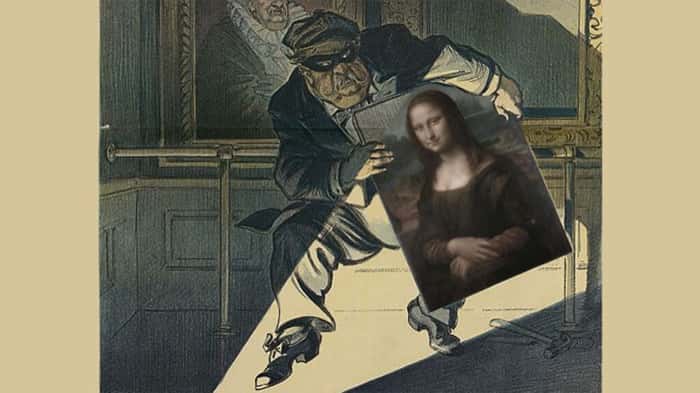
An Italian museum worker by trade, Vincenzo Peruggia would become one of history's most notorious art thieves thanks to a single audacious act: on August 21, 1911, he walked off with the Mona Lisa. According to police, Peruggia had concealed himself inside the museum the day before, well aware that it would be closed the following day.
The true motivation behind Vincenzo Peruggia's brazen theft remains something of a mystery. One popular theory points to an Italian con man named Eduardo de Valfierno, who allegedly masterminded the scheme with plans to produce forgeries and sell them off as the stolen original Mona Lisa.
A competing explanation suggested that Peruggia was driven by a desire to return the painting to the Louvre Museum in the wake of Napoleon having taken it. Napoleon had built a considerable reputation for looting Italian artworks throughout the Napoleonic wars.
When Peruggia was finally arrested, he insisted patriotism had fueled his actions — he suspected that Napoleon, himself a notorious art thief, would steal the masterpiece. The court found his argument compelling enough to show leniency, handing down a reduced sentence of just one year and 15 days.
Regardless of what truly drove him, Vincenzo Peruggia cemented his legacy as one of history's most infamous art thieves. Ironically, the Mona Lisa had actually been a gift from Leonardo da Vinci to King Francis I during the 16th Century — a full 250 years before Napoleon was even born.
Quick Facts:
Four iron pegs secured the Mona Lisa to the wall inside the Salon Carré.
Vincenzo hid the Mona Lisa in his apartment in Paris.
Peruggia returned to Italy with the painting and kept it in his apartment in Florence for some time.
Peruggia contacted Mario Fratelli, an art gallery owner in Florence, and soon after, he was caught.
After the painting's recovery, Giovanni Poggi, the director of the Uffizi Gallery, authenticated it.
The painting was finally returned to the Louvre in 1913 after exhibitions all over Italy.
Although the painting was already famous, the notoriety from the newspaper headlines and the massive search helped it gain considerable public interest.