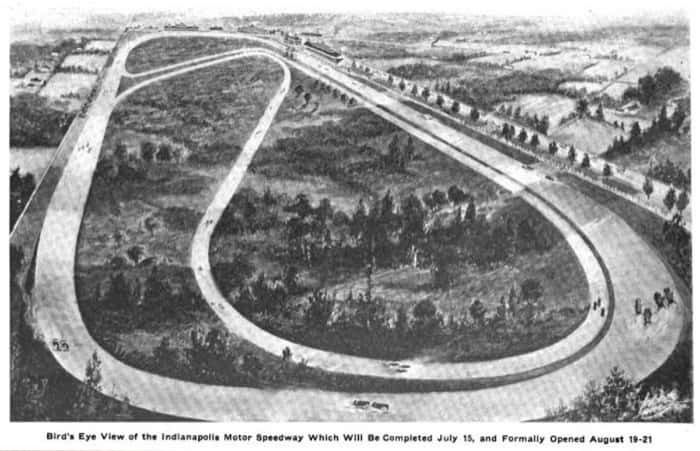
On this day in 1909, the Indianapolis Motor Speedway opened its doors for the first time. The facility would go on to earn a place on the National Register of Historic Places in 1975, followed by designation as a National Historic Landmark in 1987. This iconic automobile racing circuit once served as the home of the US Grand Prix and continues to host two major events today: the Indianapolis 500 and the Verizon 200.
Spanning 328 acres of what had previously been farmland, the Speedway came to life thanks to a group of local businessmen who envisioned it as a testing ground for the area's booming automobile industry. Beyond that practical purpose, the founders also planned to stage races from time to time, pitting different manufacturers against one another on the track.
A tradition dating back to 1936 has seen every Indy 500 champion receive a pace car as part of their victory spoils. In more recent decades, this tradition has expanded to include an official street-legal pace car replica presented to the race winner.
Quick Facts:
- The Speedway was constructed at $3 Million, the equivalent of $86 Million currently.
- The Speedway's construction broke ground on March 15, 1909 and took 5 months. It was completed August 14 of the same year.
- The rectangular, oval dimensions of the Indianapolis Motor Speedway have remained unchanged since its construction.
- The Indianapolis Motor Speedway was designed by architects Carl G. Fisher, F.H. Wheeler, James A. Allison, and Arthur C. Newby.
- The Indianapolis Speedway has four distinct turns and straightaways, and this layout has remained unchanged.
- General Motors exclusively provides all pace cars used in racing.
- Pacemaker Carl G. Fisher drove the Stoddard Dayton on the Indianapolis speedway in 1911.