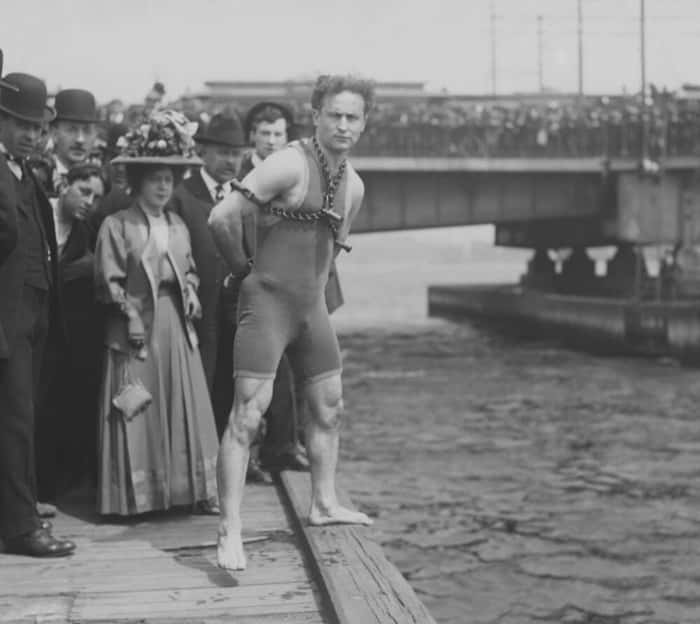
From a young age, Erik Weisz — a Hungarian-born magician — found himself captivated by the world of magic. He first made a name for himself in the United States on the vaudeville circuit. It was during a run of performances at Coney Island with his brother that he crossed paths with Wilhelmina Beatrice "Bess" Rahner, a fellow performer they later married. As he toured across Europe, he became far more widely recognized under the stage name Harry "Handcuff" Houdini. Over time, he evolved his act to include daring escapes from straitjackets, chains, and even a milk can submerged underwater. Though Houdini wore many hats — stunt performer, illusionist — it was his breathtaking escape acts that truly cemented his legend.
The date was August 26, 1907, and the time was 12:30 pm. A crowd gathered at the Aquatic Park in San Francisco to witness something extraordinary. Houdini, his hands cuffed behind his back and weighed down by a ball and chain totaling over 75 pounds (34.02 kg), leaped from the foot of the Washington Street Pier straight into the San Francisco Bay. Despite powerful tides and currents, the illusionist broke free from his restraints beneath the surface in a mere 57 seconds. It was a feat he would go on to replicate many times throughout his career.
Houdini's final performance took place on October 24, 1926, at the Garrick Theater in Detroit, Michigan, and it was nothing short of agonizing. That evening, he pushed through extreme pain while running a fever of 104 degrees Fahrenheit (40 °C). A doctor had already examined him and delivered a diagnosis of acute appendicitis, urging him to undergo surgery immediately. Houdini refused, choosing instead to carry on with the show. He ultimately collapsed during the performance and was rushed to Grace Hospital, where he was admitted. On October 31, 1926, Harry Houdini died at the age of 52 in Room 401 of Detroit's Grace Hospital, the cause being a ruptured appendix that led to peritonitis.