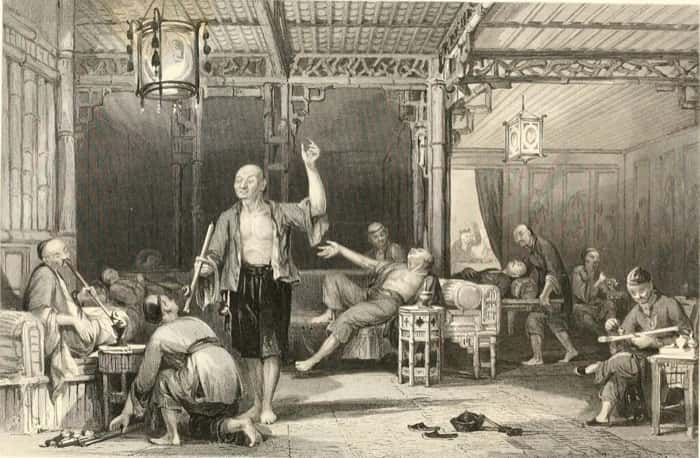
Opioids today are largely confined to the worlds of addiction and end-of-life care in America, but the story of this drug stretches back to an era when its use was far more commonplace. Throughout the 18th and 19th centuries, Chinese citizens regularly ate, drank, or smoked opium as a way to achieve feelings of well being, euphoria and relaxation. Interestingly, it was the widespread practice of tobacco smoking in 17th century America that helped shape China's own smoking culture — the nation adopted tobacco use, which eventually paved the way for opium smoking to take hold.
How The Chinese Opium Problem Began
Arab and Turkish traders were the ones who first brought opium into China, where it initially served a modest role as a pain reliever used in limited quantities. It wasn't long before Great Britain saw an opportunity and began exporting Opium from India to sell in China, turning the substance into a major trade commodity. The arrangement worked out handsomely for the British, who received luxury goods like porcelain, tea and silk in return — but for the Chinese, it meant a deepening addiction that fueled serious social and economic problems.
The scale of China's Opium imports tells a staggering story: from just 200 chests each year in 1729, the figure ballooned to 40,000 chests a year by 1838. When the Qing dynasty tried to rein in the nation's growing dependence, they were met with hostility. This resistance erupted into two conflicts known as the Opium Wars, both of which China lost — plunging the country into even greater unrest.
The End of The Opium Trade
By 1906, Western trade with China had declined enough to give the Qing government the leverage it needed to regulate the trade, growth, and use of Opium. The following year, China's government entered into an agreement with India aimed at halting the native cultivation and consumption of Opium. These efforts bore fruit — by 1917, the Chinese opium trade had been almost entirely stopped.
The Second World War brought another disruption when opium trade routes extending from southeastern to southwestern India were closed temporarily. Then, by 1949, opium smoking was finally eradicated altogether, thanks to the Chinese communist.