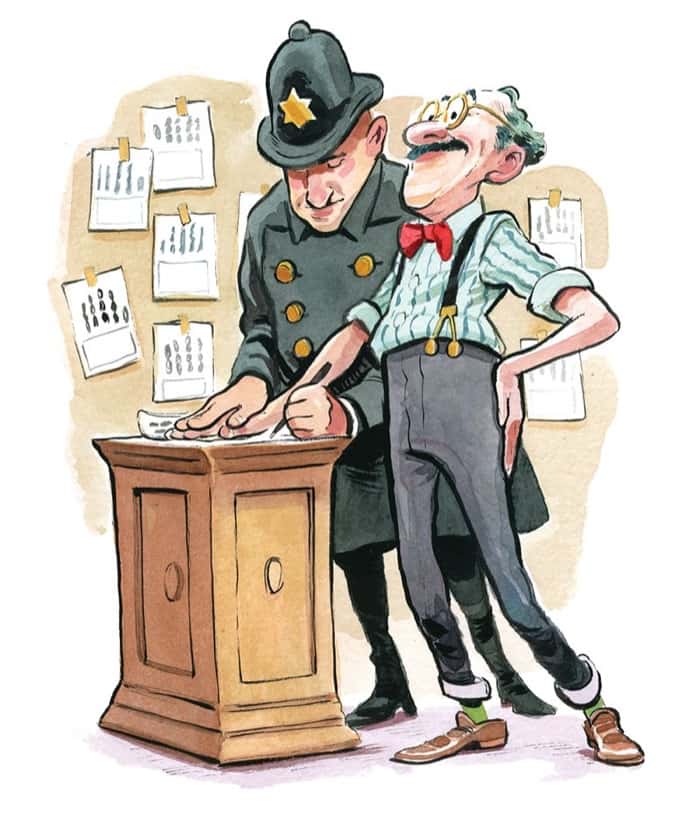
On October 28, 1904, the Saint Louis Police Department made a groundbreaking move by adopting fingerprints as a tool for identifying potential subjects in investigations. The concept of using fingerprints for identification, however, was far from new — it stretched back thousands of years to the era of Hammurabi, who referenced fingerprinted wax seals.
Recognizing patterns comes naturally to humans, and at its core, that's really all fingerprint analysis is — pattern recognition. Now jump ahead a few millennia to the 1904 Louisiana Purchase Exposition. The Saint Louis Police Department, already under considerable strain from the crowds flocking to the Exposition, witnessed a demonstration showcasing fingerprint identification through the brand new Henry Classification System.
A Catalog of Arches, Loops and Whorls
How St. Louis earned the distinction of becoming the first City in the nation to employ fingerprints in police work is a tale full of unexpected plot twists. Experts had long recognized that fingerprints were unique to each individual, yet hardly anyone had figured out how to organize and retrieve them the way you might flip through entries in a card catalog.
The key breakthrough arrived when Sir Francis Galton examined a collection of fingerprints and identified what he described as patterns of arches, loops, and whorls. From there, he built a system that categorized the different types of these distinct patterns, laying the groundwork for identification across multiple points of comparison. Galton had been immersed in fingerprint science for many years before Saint Louis ever adopted a system rooted in his research. So what's the connection between Galton and Saint Louis?
As it turns out, Sir Francis Galton was both a cousin and intellectual contemporary of Charles Darwin. Dr. Henry Faulds, a colleague of Darwin who had been conducting his own research into fingerprint science, reached out to Darwin seeking assistance. Darwin wasn't able to offer much help but did agree to pass along Fauld's results to his cousin. At the same time, Sir Edward Henry of Scotland Yard had been developing a similar system with origins in British-occupied India.
Back across the Atlantic, Saint Louis was gearing up for the 1904 Louisiana Purchase Exposition in Saint Louis (commonly called the 1904 World's Fair). England's Scotland Yard, which had been building out a fingerprint ID system, planned to unveil it to a global audience at the Exposition. Yet this wasn't what captured the public's imagination. Instead, fairgoers raved about cultural attractions, like the food and the Crown Jewels, among other things.