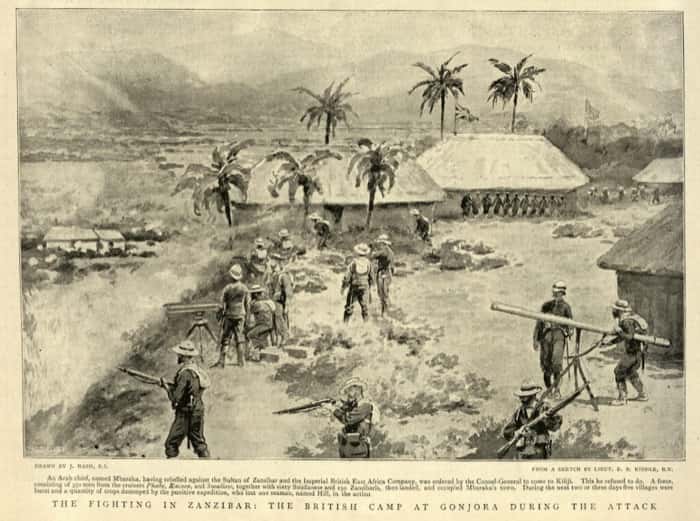
What happens when a global empire squares off against a small island sultanate? In 1896, the answer came in just 38 minutes. The Anglo-Zanzibar Military conflict between the UK and Zanzibar Sultanate erupted as a direct response to Sultan Khalid bin Barghash seizing power following the death of the pro-British Sultan Hamad.
So why was this the shortest war in human history? It all came down to who sat on the throne — and whether the British approved. The figure they favored was Hamoud bin Mohammed, not Sultan Khalid bin Barghash, who had bypassed a critical requirement: under the 1890 British Protectorate agreement, he needed permission from the British consul before ascending to power, and he never sought it.
The fighting itself was devastatingly one-sided and shockingly brief. British forces reduced the palace's artillery to rubble, set the entire palace ablaze, and brought the palace flag crashing down. The toll was staggeringly lopsided — the Sultan's forces sustained about 500 casualties, whereas the British side suffered just a single injured sailor.
Terrified by the overwhelming assault, Sultan Khalid abandoned his position and sought asylum at the German consulate, eventually escaping to present-day Tanzania. With Khalid out of the picture, the British wasted no time installing Hamoud as the head of what was essentially a puppet government. This swift regime change effectively extinguished the Zanzibar Sultanate's sovereignty and ushered in an era of deeper British influence.
Fun Facts:
The British authorities preferred Hamoud bin Mohammed; they saw him as a preferable successor who could coordinate British interests as Sultan.
Sultan Khalid did not obtain permission from the British consul before accession, as was the requirement.
The battle for Zanzibar lasted a brief 38 minutes- the shortest war in history! By contrast, the Reconquista war between the English Christian and Muslims (Moors) lasted 781 years, the longest in history.
About 2,800 Zanzibaris defended the Palace, including civilians, palace guards, and enslaved people and servants.
After 38 minutes of fighting, the Brits shot the palace flag down, ending the war.