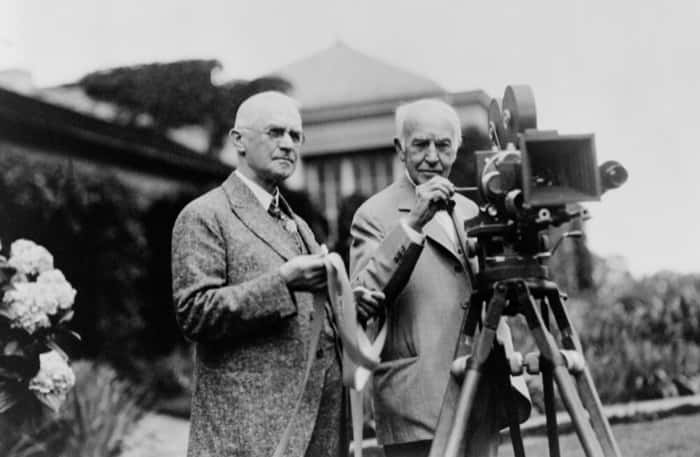
What a landmark moment in the history of entertainment: on August 24th, 1891, Thomas Edison received a patent for his groundbreaking creation, the Kinetograph. This revolutionary motion picture camera relied on a fairly simple setup — a wooden cabinet, roughly 50 feet of 35 mm film, and a sprocket wheel powered by electricity.
So how did someone actually watch one of these early movies? They peered through a peephole positioned at the top of the box, where a magnifying lens gave them a view of the images within. Down at the bottom, an electric lamp provided illumination for the images, while a revolving shutter created the illusion of continuous motion — delivering that magical sensation of a moving picture.
Of course, devices capable of projecting images already existed before this milestone. "Magic lanterns," for instance, relied on glass slides to cast images for viewers. But the Kinetograph represented a significant leap forward in affordability and went on to shape the development of motion picture technology for years afterward.
A prototype made its public debut on May 20, 1891, when it was demonstrated before the National Federation of Women's Clubs. Those in attendance got brief glimpses of frames displayed on 18 mm film, rather than the 35 mm version that would ultimately be used. By 1892, the Kinetoscope was finished — a collaborative effort involving several of Edison's assistants, among them photographer William Kennedy, Laurie Dickson, Charles A. Brown, and other laboratory workers.
That said, the extent of Edison's personal involvement in building the Kinetograph remains a matter of considerable debate. While the original concept is credited to him, the hands-on development and physical construction are thought to have been largely carried out by his laboratory assistants. Nevertheless, even though he allegedly contributed little to the actual building process, Edison claimed sole credit for the invention.