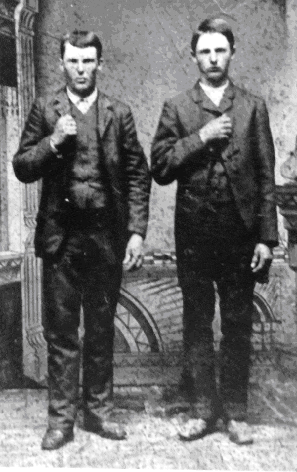
On January 7, 1874, Jesse James and his band of outlaws descended upon Gads Hill, Missouri, intent on refilling their coffers. The crew — Jesse, Frank, and three of the Younger brothers — seized control of the town's general store and held the local residents hostage while they waited for the 4:00 train to pull in. When it finally showed up forty-five minutes late, the five outlaws brought it to a halt by setting a bonfire ablaze on the tracks and waving a red flag.
Once the train began to slow, the gang sprang into action, leaping aboard with practiced efficiency. Two of the men kept passengers and crew in check at gunpoint, while the remaining three tore through the safe, cargo, and mail bags. The haul from the cargo turned out to be disappointingly slim, so the bandits moved through the train cars, shaking down the riders for whatever cash they carried.
What made this robbery particularly memorable was the gang's peculiar code of conduct. The James and Younger brothers steered clear of women and working men — they actually inspected passengers' hands for calluses, only relieving those with "soft" hands of their valuables. Witnesses recalled the outlaws being remarkably cheerful throughout the ordeal, cracking jokes and bowing graciously to the ladies. And in a truly theatrical flourish, Frank James delivered a few lines from William Shakespeare before the gang stepped off the train. The precise passage has been lost to history, though it may have been drawn from King Henry IV, which features a highway robbery set in the English town of Gad's Hill — the very place for which Gads Hill, Missouri was named.
All told, the gang rode off with $12,000, equivalent to roughly $312,000 present day. Beyond the money, they etched their names into the history books by pulling off the first train robbery in Missouri. It wasn't their biggest score, but it cemented their reputation as Western Robin Hoods. Of course, whether that image reflects reality or was deliberately cultivated by the James brothers remains impossible to determine. The gang ultimately fell apart in 1876 following a botched bank robbery.