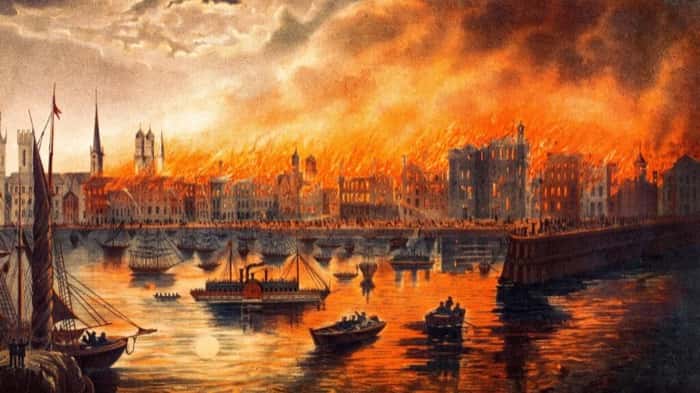
An oppressive heat wave had settled over the Midwest in October 1871, making conditions dangerously dry. Rainfall throughout the summer had been just a fraction of what was typical, leaving the city's wooden buildings and sidewalks parched and vulnerable. The exact timing and cause remain unknown, but a fire reportedly ignited one evening inside a barn belonging to Patrick and Catherine O'Leary. It would rage for days before autumn rains — in a cruel twist of irony — finally helped bring the blaze under control. When residents began to assess the aftermath, they found that a vast stretch of downtown Chicago had been reduced to nothing but smoldering ash.
Damages
The devastating Great Chicago Fire of October 10, 1871, left behind roughly $222 million in destruction — a sum equivalent to more than $3 billion in today's dollars. A swath of the city stretching four miles long by one mile wide was completely leveled, and about 90,000 people were displaced after their homes and businesses were utterly destroyed.
The death toll reached an estimated 300, although 180 bodies were never recovered. The inferno swept through more than 70 miles of streets where 17,500 buildings stood — all constructed from brittle, dried-out wood that was practically fuel waiting for a spark.
How it Started
Even after more than 140 years, the origins of the Great Chicago Fire — the blaze that reshaped swaths of downtown — remain shrouded in mystery. That famous tale about O'Leary's cow kicking over a lantern? It was merely a narrative cooked up by a Chicago newspaper looking to sensationalize the disaster and boost sales. Other explanations have circulated as well: one theory suggests someone knocked over the lantern while fleeing an illegal card game, while yet another points to a meteor strike as the culprit. Naturally, some of these ideas hold up better than others. Still, the enduring uncertainty only deepens the folklore surrounding one of America's most infamous disasters.