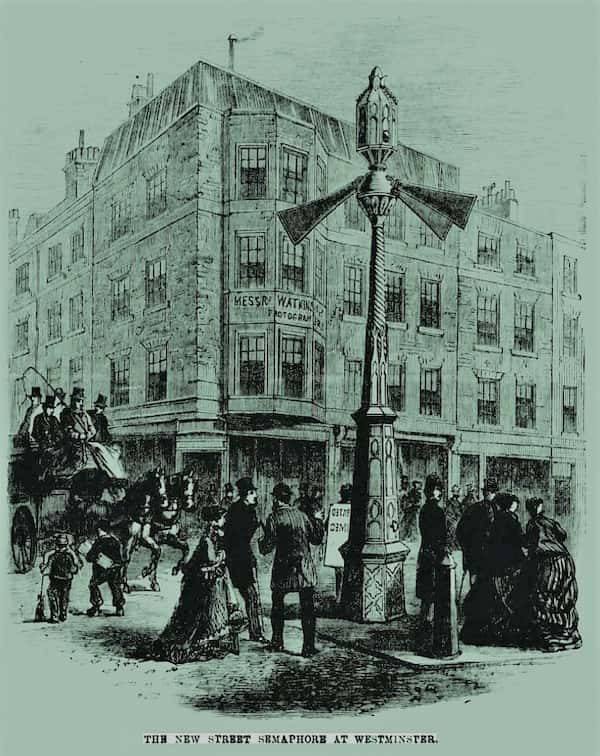
On December 9, 1868, history was made when the very first traffic lights found their home just outside the Palace of Westminster (House of Parliament).
Traffic Lights For the Railroad
The mind behind this innovation was J P Knight, an engineer who had built his career in railway signaling. What prompted the creation? The junction near Parliament had become dangerously chaotic — just months earlier, it had been the site of separate incidents that left 2 MPs injured and claimed the life of a policeman.
In design, these early traffic signals bore a striking resemblance to the railway signals we recognize today. A lever-operated mechanism caused two mobile signs to pivot into position. The operators were responsible for waving semaphore arms equipped with green and red lamps, all powered by hot gas.
A gas position at 45 signaled green, giving cars permission to proceed with caution. Raising it switched the light to red, bringing vehicles to a stop so pedestrians could safely cross.
The device had a major limitation, though — it proved far from effective and could only be used at night, when the illuminated lamps were actually visible.
A Short-Lived Invention
Public reaction turned out to be decidedly mixed. Some people simply couldn't make sense of the symbols, and others chose to disregard them entirely.
Tragically, the experiment was cut short when the traffic light exploded without warning, killing a police officer in the process. That fatal accident brought production to a complete standstill, and the concept was effectively shelved until the age of combustion engines arrived. Only when better energy sources became available did anyone seriously revisit the idea of using traffic lights to manage the flow of vehicles and pedestrians.