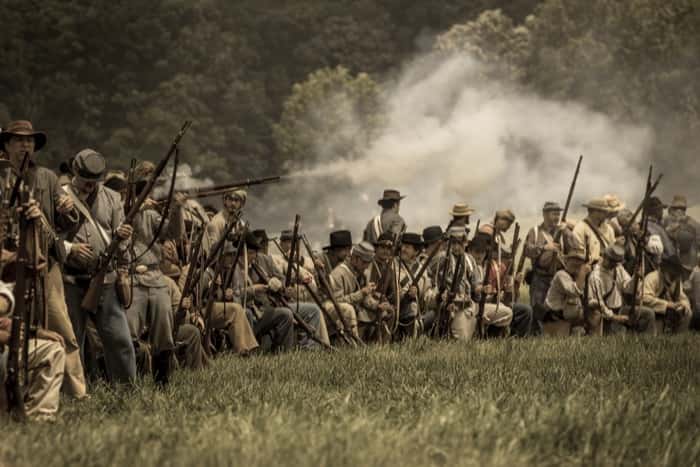
On this day in 1863, the bloodiest battle in American history got underway at Gettysburg.
General Lee moved with urgency on this first day, pulling together Confederate forces at Gettysburg with the goal of engaging and crushing the Union Cavalry. It was General Henry Heth who commanded the Confederate division that began its march into Gettysburg on July 1, 1863. What they expected to be a mission to seize supplies and claim territory quickly ran into an obstacle — three brigades of Union cavalry standing in their path.
Leading that Union cavalry resistance was Brigadier General John Buford, whose Brigade managed to slow General Henry Heth's push into Gettysburg while they awaited the arrival of reinforcements. Those reinforcements came at about 11:00 AM, when John F. Reynolds's I corps reached the field and bolstered a counterattack that inflicted casualties on both sides.
The Confederate advance lost momentum as a result of this attack. But the tide shifted again when Confederate infantry reinforcements commanded by generals Richard Ewell and A.P. Hill arrived and overpowered the Union positions. With 24,000 Confederates bearing down on just 19,000 Federals, the quickly assembled Union lines buckled and collapsed, pushing the defenders back to Cemetery Hill. Yet the Confederates held off from pressing their attack on Cemetery Hill, uncertain about the true strength and positioning of the enemy forces.
Arriving at about 4:00 PM, General Winfield Scott Hancock took stock of Meade's situation and came to a decisive conclusion — Gettysburg was where they would make their stand. He promptly directed III Corps and XII Corps, led by Generals Daniel Sickles and Henry Slocum, to advance forward.