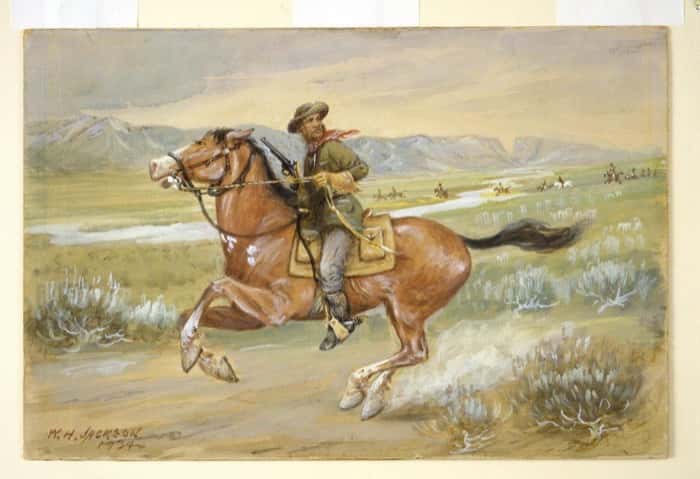
There was a time when daring young riders on horseback carried mail across the vast stretch from Missouri to California. That inaugural trip covered the distance in just ten days. Serving as one of the most direct and practical east-west communication systems of 1860, the route along the Pony Express National Historic Trail linked as many as eight states. Thanks to these riders, letters could travel from Missouri to California faster than any previous method allowed.
Before the age of electronic communication, the Pony Express served as the vital lifeline tying the Eastern and Western halves of the nation together. Its operational life was remarkably brief—just 18 months, spanning from April 1860 to October 1861—yet its impact was powerful enough to transform the Old West.
The demand for rapid mail delivery had deep roots. The 1847 Mormon exodus to Utah and the 1849 Gold Rush both fueled an urgent need for speedy postal services. Meanwhile, the Oregon Trail, which began drawing waves of settlers starting in the 1840s, triggered a massive westward migration of people eager to send letters across the Rocky Mountains. Partial relief came in 1857 with the launch of the Butterfield Overland Mail Service, and private carriers stepped in to fill remaining gaps in the years that followed.
A pivotal shift came in 1858, when postmaster general Joseph Holt relocated overland mail service to California and the central region. This proved to be an unexpected boon for the mail industry, as it generated even greater demand for postal delivery. Out of this growing need emerged the Leavenworth & Pike's Peak Express Company, built up by William H. Russell, Alexander Majors, and William B. Waddell. Eventually, the company would take on the name we remember today: Pony Express.
Just ten weeks into Pony Express operations, a landmark decision reshaped the future of long-distance communication. On June 16, 1860, Congress authorized a bill directing the Secretary of the Treasury to subsidize construction of a transcontinental telegraph line. This wire would ultimately bridge the gap between the Pacific Coast and the Missouri River.
Passage of the bill led to the merger of two companies: the Pacific Telegraph Company of Nebraska and the Overland Telegraph Company of California. Throughout the construction period, the Pony Express continued its regular work, ferrying newspapers and letters between St. Joseph and Sacramento. Telegrams, meanwhile, were only transmitted between the rapidly advancing ends of the growing wire network.
On October 26, 1861, San Francisco established direct telegraph contact with New York City. It was a bittersweet milestone—for the Pony Express, it marked the end of the line. Operations were officially terminated that day, though riders were permitted to continue through November to complete delivery of all letters still in transit.
Much of the original trail has been lost to the passage of time and human development. Both the precise route and exact length of the path remain largely a matter of guesswork. Across the western states, former Pony Express routes have been converted into double-track dirt roads. Only short pristine sections, found in Utah and California, are believed to be surviving remnants of the original trail. Still, an estimated 120 historic sites may eventually be opened to the public, along with roughly 50 remaining Pony Express stations.