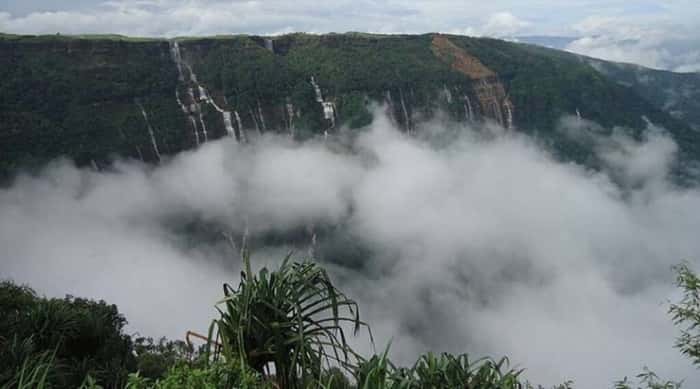
Sohra, more commonly referred to as Cherrapunji, sits in the East Khasi Hills of Meghalaya, India. This town has long served as the traditional capital of ka him Sohra, the Khasi tribal Kingdom.
For most people, rainfall is something measured in mere millimeters at a time. Unless, of course, you've spent time in India — a country where annual rainfall averages a staggering 118 cm, or 3.87 feet.
While Sohra has always been known for receiving well above average rainfall on a yearly basis, it was in 1861 that the city shattered the world record — a title it continues to hold to this day!
The Great Rain of 1861
Sohra's subtropical highland climate makes it particularly vulnerable to monsoons, much like many other cities sharing similar conditions. These powerful seasonal winds unleash torrential downpours over a span of approximately six months, then reverse course and usher in dry air for the remainder of the year.
The region is battered by monsoon winds arriving from both the southwest and northeast. Because the windward-facing slopes of the Khasi hills amplify precipitation rates, the area typically sees substantial rainfall. But in 1861, conditions aligned perfectly — and the results were extraordinary. That year, Sohra was drenched by over 75 feet of rain, with an astonishing 30 feet falling during July alone!
The Wettest City…Stuck In A Drought?
It sounds paradoxical, but Sohra — one of the wettest cities on the planet — routinely suffers from droughts when the dry season arrives. Years of overfarming combined with relentless heavy rainfall have stripped the land of quality topsoil through erosion, leaving the ground unable to hold moisture effectively. Because irrigation techniques remain limited, most of the water simply flows off into nearby towns. The water scarcity becomes so severe during dry months that residents must travel significant distances just to obtain potable drinking.
Quick Facts:
- Sohra receives rains from the Bay of Bengal during the Indian summer monsoon.
- Monsoon clouds travel over 400km before they hit the Khasi Hills and rise abruptly to 1,370, above sea level within 2 to 5km.
- The city receives approximately 39 feet of rain each year.
- As of 2012, the town had a population of 10,086 people. The locals living in the area are known as Khasis. The community is a matrilineal culture.
- The area gets about 11,777 millimeters which is lower than the nearby 11,873 mm in Meghalaya.
- Average temperatures range from 11.5 °C in January to 20.6 °C in August. The annual temperature is 17.3 °C.