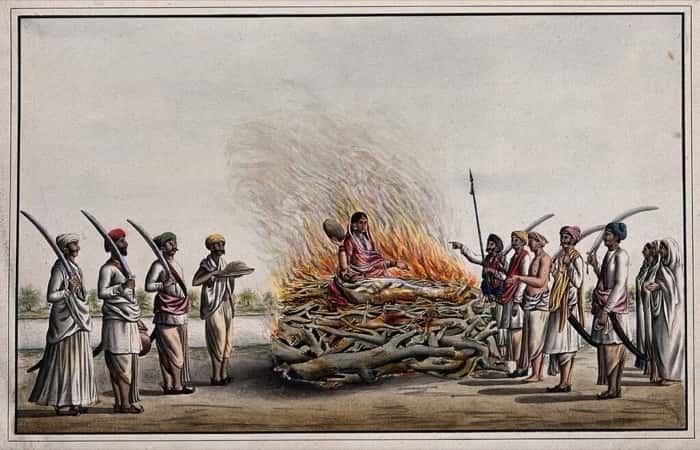
Suttee — also known as sati — is a centuries-old Indian tradition in which a widow ends her own life shortly after her husband's death as an expression of profound devotion to him. Records of this ritual stretch back to at least 510 CE, and suttee stone memorials can be found scattered across the Indian landscape as lasting reminders of its long history.
Suttee Origins
The roots of this practice are intertwined with the story of the Hindu goddess Sati. According to tradition, she took her own life after enduring humiliation directed at both herself and her husband by her father. Following her death, her grieving husband carried her body across the land, and wherever her body parts fell, sacred pilgrimage sites emerged.
Originally, suttee was associated with virtuous, devoted women who chose of their own free will to follow their husbands into death. By doing so, these widows demonstrated unwavering loyalty and sought to accumulate significant karma in the afterlife. As a memorial, many of them pressed a handprint or footprint into stone before their sacrifice.
Over time, though, the custom took a darker turn. Widows increasingly found themselves forced into suttee when they were seen as burdens on society. Certain exemptions did exist — pregnant women, those with young children, and menstruating widows were spared. Women belonging to the highest social class were also exempt, since they were considered to have nothing to gain spiritually from such an act.
Suttee Bans
A coalition of Christian and Hindu reformers drove the movement to abolish suttee, united in their conviction that the practice was inhumane and overwhelmingly forced upon its victims. The first official British prohibition came in 1798, though it applied only to Calcutta. This era coincided with a surge in missionary activity across India, fueled by efforts to spread Christianity and eliminate practices deemed morally degrading. Yet the ban proved largely ineffective — 438 instances of suttee were documented in the city in 1803 alone, and between 1815-1818, the recorded number soared to 839.
A more sweeping measure came in 1829 when Lord WIlliam Benticnk, serving as the British Governor-General of India, introduced the Bengal Sati Regulation. Under this new law, anyone who aided in carrying out the ritual faced the loss of both property and freedom. Though supporters of suttee pushed back fiercely, the ban ultimately prevailed, securing the backing of four of 7 of the Privy Councillors.