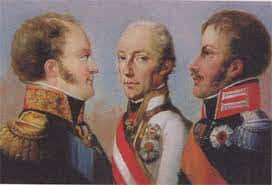
On September 26th, 1815, three of the world's most powerful nations — Russia, Prussia and Austria — came together to formalize a remarkable pact. Their goal? To restore the divine right of kings and bring Christian unity across their vast domains. Though plenty of diplomats and public servants dismissed the whole arrangement as "apocalyptic" and "nonsense," it carried enough weight among ruling leaders to be officially codified and put into practice for some number of years. Ultimately, deep geopolitical friction between Russia and Austria caused the Alliance to crumble by the 1880s.
Background
In the aftermath of Napoleon's final defeat, the Holy Alliance came into being. Tzar Alexander I of Russia was the driving force behind it, seeking to aggressively stamp out liberalism and secularism that had flourished during the brutal French Revolutionary and Napoleonic Wars. The document itself was drafted by Tzar Alexander alongside Ioannis Kappodistrias, one of Greece's most distinguished statesmen. There's a rich irony here — Kapodistrias is widely regarded as the father of modern Greece, a nation that stands as both a historical and modern bastion of liberalism and democratic ideals. Nevertheless, it seems clear that even public officials of progressive leanings had little choice but to bend to the will of the sovereigns who held power at the time.
The Alliance
Critics took aim at what they perceived as the Tsar's outsized influence over the Alliance, arguing that the document was far too "mystical" — wrapped in vague beliefs and abstract concepts that offered little practical utility for geo- and sociopolitical cohesion. The other monarchies found this deeply unsettling, and at their behest, a replacement document with a more pragmatic character was drawn up and signed.
Initially shrouded in secrecy, the Holy Alliance quickly became an object of deep suspicion among those who embraced liberalism as an ideology. The United Kingdom under George VI swiftly rejected it, and France followed suit. Still, coming on the heels of wars fueled by revolutionary ideology, the Alliance had a clear and explicit mission: to crush these impulses and ideas while forcefully imposing monarchic structure on countries that had endured such prior turmoil. By 1825 — the year Alexander died — the Alliance was widely considered defunct.