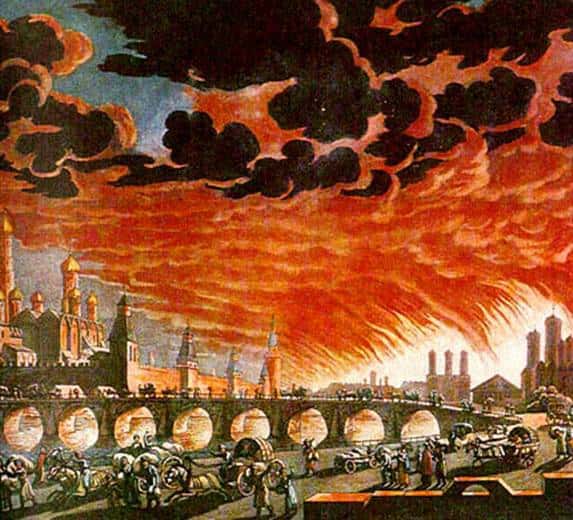
For five harrowing days, flames consumed Moscow — and the inferno's glow could be seen from an astonishing 215 km away. Though the city possessed a fire brigade, Rostopchin had already ordered that most of the firefighting equipment be removed or destroyed, leaving residents and occupiers alike virtually powerless against the spreading blaze.
It all began on September 14, when numerous small fires erupted simultaneously and rapidly spiraled beyond control. Moscow's predominantly wooden structures fed the flames, which merged into one enormous conflagration. Ordered by Rostopchin, the fires reached even the Kremlin's arsenal, though French Guardsmen managed to extinguish that particular threat. The devastation finally came to an end on September 18, 1812, after five relentless days of burning.
By the time the fires ignited, the vast majority of Moscow's inhabitants had already fled. Napoleon's forces marched into a city that was largely empty — and already engulfed. With so many wooden buildings fueling the destruction, there was little hope of bringing the situation under control.
Safe within the Kremlin's walls, French Emperor Napoleon Bonaparte nonetheless watched the catastrophe unfold with profound horror. What shook him most deeply was the sheer resolve of the Russians — their willingness to set fire to their own cherished, sacred city rather than hand it over to an invader. One witness described him standing motionless, utterly transfixed as he gazed at the inferno from the Kremlin. "What a terrible sight, so many palaces," he uttered, unable to conceal his disbelief at the spectacle before him.