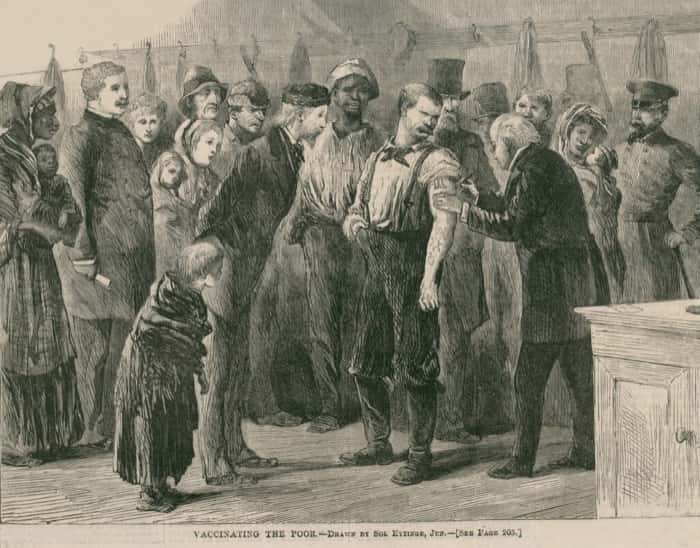
Smallpox ranked among the most devastatingly contagious viral diseases in human history, leaving survivors horribly disfigured and claiming the lives of countless others who fell victim to it. For centuries, this scourge ravaged populations across the globe, with an average of 400,000 deaths per year in Europe alone during the 18th Century, before the World Health Organization finally declared it eradicated in 1980. Communities gripped by outbreaks lived in terror, and with good reason — three out of every ten people infected would die. Entire families being wiped out was far from unusual.
One method of combating the virus was inoculation, a rough and rudimentary procedure involving the introduction of infected material into the bodies of healthy people. It showed some promise — George Washington famously employed it on his troops during the American Revolutionary War, and Abigail Adams used it on both herself and her children — yet this approach carried serious dangers of its own, sometimes proving fatal.
Then, as the 1700s drew to a close, a pivotal discovery emerged. For years, English physician Edward Jenner had listened to dairymaids share stories about how previous bouts of cowpox — a viral skin condition far milder than smallpox, though similar in nature — seemed to protect them from the deadlier disease. After conducting trials, Jenner confirmed what the dairymaids had long claimed: infection with cowpox did indeed confer immunity to smallpox. He created a vaccine based on this insight and began publishing his findings in England in 1796, though his work initially met with skepticism and pushback. Still, anecdotal evidence supporting his theory gradually spread far and wide. This is where Dr. Benjamin Waterhouse enters the story.
Born and raised in Rhode Island, Dr. Waterhouse pursued his medical education across the Atlantic — in London, Scotland, and the Netherlands. Upon his return to America in 1782, he distinguished himself as a Fellow at the Rhode Island College (today Brown University), earned fellowship in the American Academy of Arts and Sciences, and joined the faculty of the newly established Harvard Medical School in Boston.
After learning of Jenner's groundbreaking work, Waterhouse reached out by letter to President John Adams, who had been his roommate while both were studying in the Netherlands, as well as to Vice President Thomas Jefferson about the vaccine. With Jefferson's encouragement and support, Waterhouse took a bold step: on July 8, 1800, he vaccinated his own four children against smallpox — the first such vaccinations ever performed in the United States. This pioneering act set in motion a chain of events that would ultimately lead to the complete eradication of the disease from the North American continent.