On September 3rd, 1783, the United States sent three distinguished representatives — Benjamin Franklin, John Jay and John Adams — to meet with delegates of the British Crown for the formal signing of what would come to be called the Treaty of Paris.
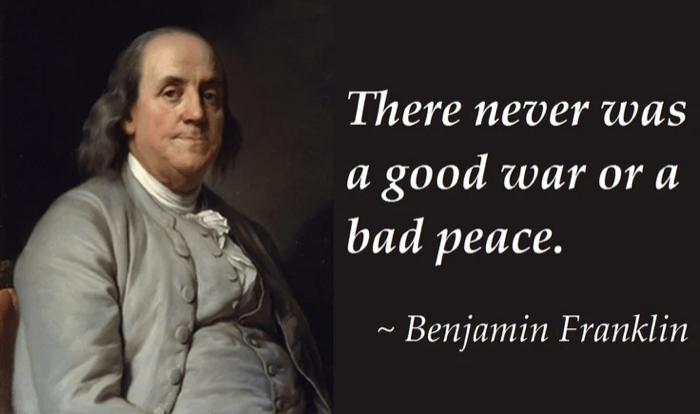
Following the signing of the Treaty of Paris, Benjamin Franklin made a memorable proclamation on September 11th, 1783: there was never a good war nor a bad peace. His words carried a powerful message — that war, regardless of the parties or causes involved, never truly serves the interests of prosperity and peace.
Fun Facts:
Originally, five Americans were selected to take part in this expedition, but uncontrollable circumstances prevented two of them from making the journey, leaving only 3 to attend.
Despite playing a central role in brokering the peace, Benjamin Franklin did not entirely believe in the Treaty.
The Treaty of Paris laid out 10 key points, the majority of which dealt with territorial terms governing the boundaries and reach of both the new Americas and the Great Britain kingdom.
Along the British Canadian coastline and the Mississippi river, the British colonies (New Americas) and Great Britain found themselves sharing common interests.
At its core, the quote "There never was a good war or bad peace" conveys the idea that wars inevitably bring losses, while peace is presumably good no matter which parties are involved.
Hostilities did not fully cease even after the Treaty of Paris was signed, as some colonies continued fighting.
Violations of the treaty's spirit occurred on both sides — in some instances, the British refused to release some of the forts located in the former northwest territory, while some Americans kept stealing from citizens who had remained loyal to the British Crown during the war.