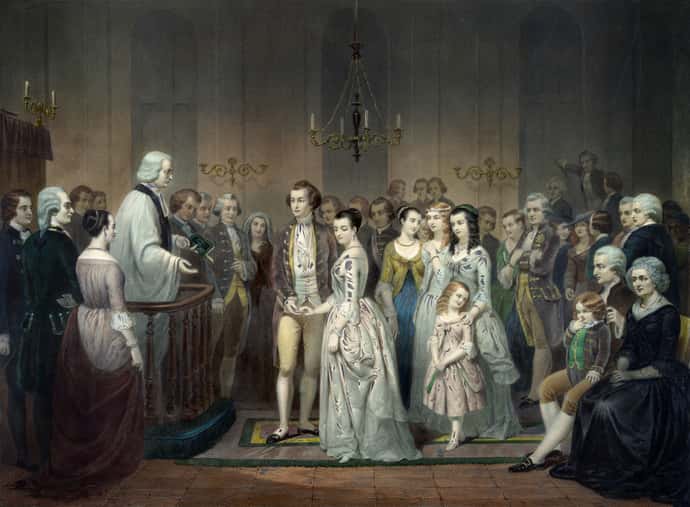
On January 6, 1759, a wedding took place that would forever link two prominent figures in colonial America. George Washington — the future leader of an armed rebellion against British rule in the New World — married Martha Dandridge Custis at the White House, the provisional capital of New Kent County. But the road to that union had its own fascinating story.
By the late 1750s, George Washington had already carved out a reputation as the commander of Virginia's provincial army. His experience battling local indigenous populations and the French in the Western Territories had earned him considerable standing. A tall, confident Colonel, George Washington moved with ease through aristocratic social circles, making him one of the most eligible bachelors around. Meanwhile, the sudden death of Daniel Parke Custis had left his widow, Martha Custis, among the wealthiest women in the New World.
Finding a new husband swiftly was not just practical for Martha Custis — it was expected. In an era when life expectancy was short and the threat of fatal diseases loomed constantly, remarriage was simply the custom of the time. She was just 26 with two children when she lost her first husband. Daniel Custis had been a wealthy man, two decades older than his young wife, and upon his passing, Martha Custis assumed control of his considerable estate — more than 3,500 acres spread across several plantations.
From what records tell us, the courtship between George Washington and Martha Custis was a brief affair, likely spanning about a year or so. Colonel Washington's military obligations and her responsibilities as a mother naturally limited their time together. Washington noted in his personal ledger a visit to Martha's plantation in New Kent County, Virginia, in 1758. After their wedding on January 6, 1759, Martha Washington and her two children joined the Colonel at his Mount Vernon estate to begin their new life together. The couple never had children of their own, though Colonel Washington would come to embrace her kids as if they were his.