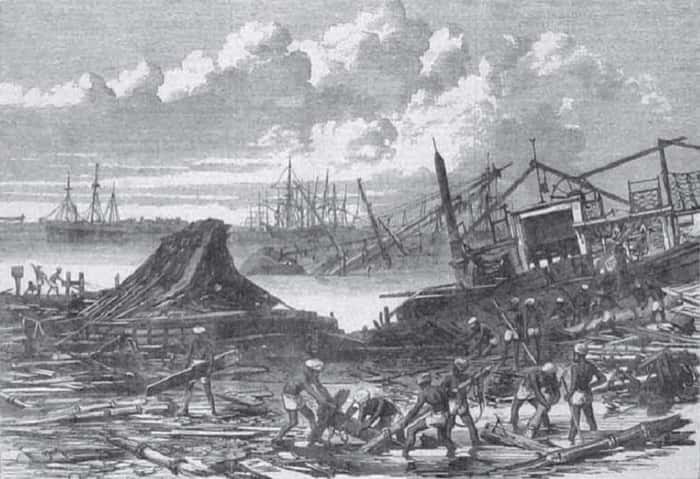
Throughout the long centuries of oceanic travel, storms ranked among the most persistent dangers faced by seafaring captains. In October 1737, one such devastating storm took shape over the North Indian Ocean before tracking northward and crashing into the mouth of the Hooghly River near Calcutta, India. While recent scientific research has identified October 11 as the actual date the storm made landfall, many sources point to October 7, 1737, as the commonly cited date when 300,000 people lost their lives. This discrepancy raises an important question — why does the difference matter, and what can we learn from it?
Understanding these powerful weather events allows officials to issue early warnings and evacuate people to safety. What likely drove the catastrophic death toll was a massive storm surge, with waves reaching an estimated 40 feet. Most people are familiar with the destructive potential of hurricanes, typhoons, and tropical cyclones. What fewer people realize, however, is that all three are essentially the same type of weather phenomenon — the only distinction comes down to which ocean provides the energy that fuels them.
Using satellite imagery and a wide array of scientific instruments, meteorologists keep a constant watch on weather patterns across the entire globe. The name given to one of these storms is purely a matter of geography. Storms born in the Northeast Pacific and Atlantic Oceans are called hurricanes. Those that develop in the Northwest Pacific Ocean earn the label typhoon. And when these systems form over the South Pacific and Indian Oceans, they're known as tropical cyclones.
It all begins when a mass of clouds starts rotating around a central area of low barometric pressure — at that point, meteorologists begin tracking it as a tropical depression, characterized by potential maximum sustained winds between 0 and 38 mph. Should the system intensify and spin faster, generating maximum sustained winds of 39 to 74 mph, it graduates to tropical storm status. Once sustained winds hit 75 mph, meteorologists reclassify the system from a storm to a full-blown cyclone.
Facts About the Cyclone of 1737:
- While no one knows the exact number, experts estimate that 300,000 people died as a result of the 1737 Hooghly River Cyclone.
- The Cyclone hit 270 km/h for one minute and 260 km/h for three minutes.
- The Ganges accumulated 15 inches of rain in six hours.
- The area is prone to tropical cyclones. Storms with death tolls over 10,000 were recorded in 1787, 1789, 1822, 1833, 1839, 1864, and 1876.