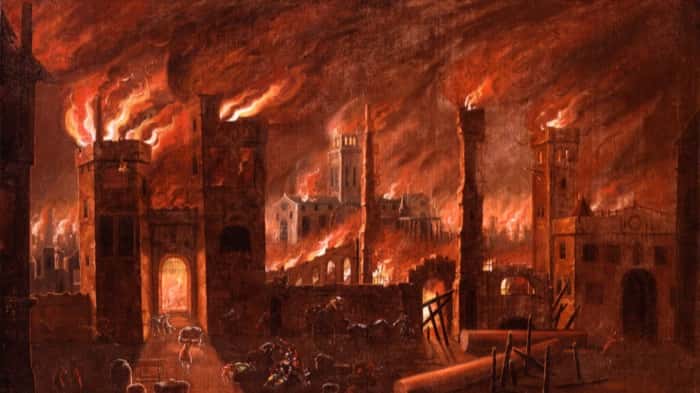
It was a Sunday — September 2, 1666 — when flames tore through London in what would become one of the most catastrophic urban disasters in English history: the Great Fire of London.
The blaze started by accident, originating in the house of the King's baker on Pudding Lane, not far from London Bridge. Farriner, along with his family and a servant, narrowly escaped by climbing out through an upstairs window. Tragically, a bakery assistant was not so fortunate and perished in the flames.
For four relentless days, fierce east winds drove the fire forward, consuming almost five-sixths of London before it was ultimately brought under control. It took gunpowder to finally stamp out the inferno on September 6. Official records cite only six deaths, though historians have long questioned whether that figure tells the full story.
Quick Facts:
- Erupting on September 2, 1666, the Great Fire of London raged for four complete days, not coming to an end until September 6.
- On the evening of September 1, 1666, Thomas Farriner, baker to King Charles II, went to bed without properly extinguishing his oven. During the early morning hours, a spark leapt from the oven and caught a pile of firewood sitting nearby. Within a short time, his entire house was engulfed, and the fire started spreading beyond its walls.
- Among all the destruction wrought by the Great Fire of London, perhaps nothing was more significant than the complete wreckage of St Paul's Cathedral.
- Powerful easterly winds turned the blaze into a sweeping inferno that surged across the city. Making matters worse, medieval London's cramped streets and tightly packed oak timber houses offered virtually no resistance to the advancing flames.
- No national fire service existed at the time, leaving ordinary citizens to fight the disaster with whatever crude tools were available — entire neighborhoods turned out carrying pails of water and operating primitive hand pumps in desperate attempts to beat back the fire.
- Only six verified deaths appear in the official records of the Great Fire of London. That said, a number of historians contend the true death toll was likely higher, pointing out that fatalities among poor and middle-class people went unrecorded, and that the intense heat of the fire left no recognizable remains of its victims.
- Several figures — Walter Gostelo, Ursula Southeil, William Lilly, and Nostradamus — made prophecies that some have connected to the Great Fire's prediction. In 1661, John Evelyn raised alarms about the danger of fire in the city. Then, three years later in 1664, Charles II personally wrote to the Lord Mayor of London, urging the enforcement of building regulations as a measure to help contain fires.