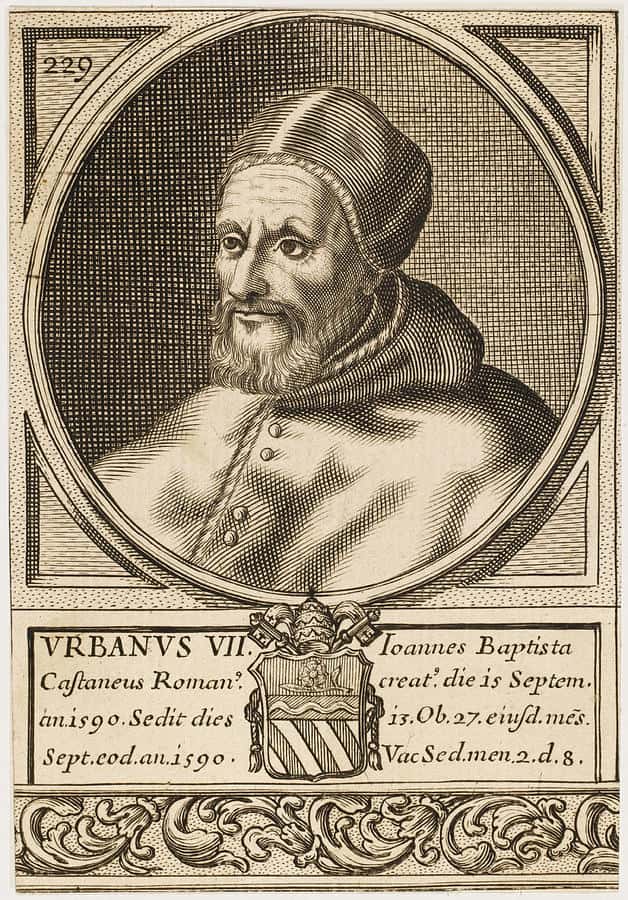
Giovanni Battista Castagna, who would become Pope Urban VII (1521-1590), holds a remarkable distinction in papal history — his reign lasted a mere 13 days, concluding on September 27, 1590. Tragically, malaria claimed his life before he could even be consecrated.
Background
A man of impressive academic credentials, Castagna pursued his education across several Italian universities, ultimately earning a doctorate in Civil and Canon Law at the University of Bologna. Before his elevation to the cardinalate, he gained substantial administrative experience serving as governor of various cities.
Papacy
On September 15, 1590, Castagna ascended to the papal throne as Pope Urban VII.
Among his most notable acts was issuing what is considered the world's first public smoking ban. Under this proclamation, anyone caught chewing, inhaling or sniffing tobacco inside a church or in its porchway faced the swift penalty of excommunication.
But his brief time as pontiff extended well beyond that singular decree. Pope Urban VII distinguished himself through generous charitable endeavors — he subsidized Roman bakers to enable them to sell their goods below market price points and imposed restrictions on luxury goods purchases for members of his court. Beyond these measures, he directed investment into public works projects across the Papal States of Lazio (which included much of Rome), Marche, Umbria and Romagna, as well as parts of Emilia. Though remarkably short-lived, his dual role as both secular and religious leader proved to be extraordinarily expansive in scope.
Death
On September 27th, 1590, malaria brought Pope Urban VII's life to an end in Rome. He was laid to rest in the Vatican, and his entire estate was bequeathed to the support of poor girls.
Legacy
For the people of Italy, Castagna's reign was something to celebrate. His fierce stance against nepotism stood out as a defining virtue, one that kept him elevated in both the Church's and the public's estimation for years to come. Moreover, the prudence and acumen he demonstrated in administrative affairs left a significant mark on the broader history of the papacy.