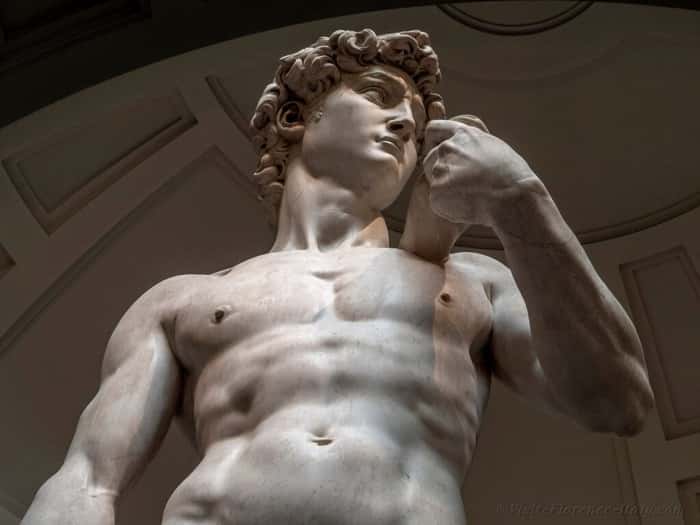
On September 8, 1504, in Florence, Italy, Michelangelo Buonarroti presented the world with his breathtaking Statue of David — a towering 17-foot tall masterpiece carved from white Italian Carrara marble and weighing in at a staggering 12,000 lbs. The imposing work portrays a naked David, the Biblical King famous for slaying Goliath with a slingshot.
Three years of painstaking sculpting went into bringing the Statue of David to life before Michelangelo finally revealed it to the public on September 8, 1504, in Florence, Italy. What makes the achievement even more remarkable is that Michelangelo worked from a block of marble that other artists had dismissed as flawed — yet he transformed it into a testament to his extraordinary sculpting mastery.
The sculpture captures the Biblical King David, celebrated for defeating the Philistine giant, Goliath, with nothing more than a slingshot. Originally commissioned in 1501 by the Opera del Duomo as a nude statue intended for the Cathedral of Florence, the work demanded three years of meticulous effort to sculpt to perfection.
The original plan called for the Statue of David to join a collection of statues adorning the cathedral's roofline. But when it came time to hoist the 6-ton creation into place, the sheer difficulty of the heavy lifting made that impractical. Instead, the statue found its ideal home at the Piazza, where it could be openly admired by the public.
Landing this commission was a moment of immense pride for the 26-year-old Michelangelo. Where most earlier sculptures had portrayed David as a boy, Michelangelo boldly reimagined him as a muscular man, gripping a sling in his left hand and clutching a rock in his right. To this day, countless artists and art enthusiasts regard the statue as one of the most exquisite examples of high renaissance art.