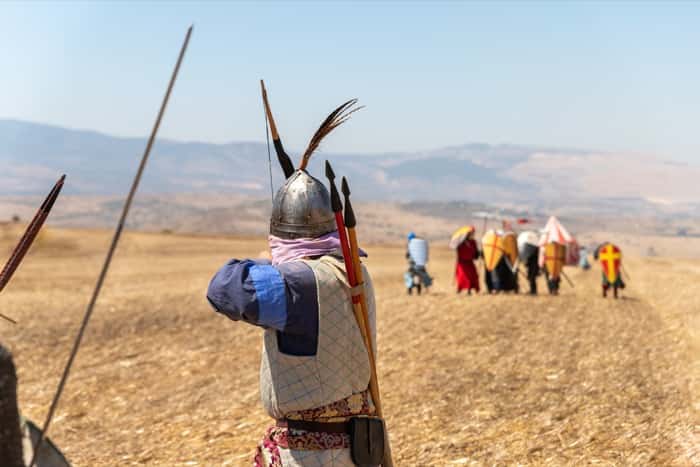
No single clash during the Second Crusade proved more consequential than the Battle of the Horns of Hattin. Fought across two grueling days — July 3 and July 4, 1187 — it pitted the Crusaders of the Levant against the forces of Saladin, the formidable Sultan of Egypt and Syria. The engagement drew its name from the distinctive horn-shaped volcano known as Kurûn Hattîn.
Saladin's armies succeeded in killing or capturing a vast portion of the Crusader forces during this engagement, effectively destroying their ability to wage further war. With this decisive victory, Muslim forces reasserted themselves as the dominant power across the Holy Land. City after city that had been in Crusader hands fell in the aftermath — including, most notably, Jerusalem itself. The sheer scale of this defeat and the territorial losses that followed directly sparked what we now call the Third Crusade, launched in 1189, a mere two years after the catastrophe at Hattin.
What made the Battle of the Horns of Hattin so devastating was, remarkably, the simplicity of the strategy behind it. Under cover of darkness on the night of July 3rd, Saladin's troops ignited the dry grass covering the plains, driving the desperate Crusaders toward the springs of Hattin. Before long, the choking smoke blinded them, and thirst and exhaustion sapped what strength remained. With no viable escape route left, they were funneled toward the Horns of Hattin — right into the waiting Muslim forces. The Crusaders tried three times to punch through the Muslim lines, and three times they failed. Those still on their feet had no choice but to surrender.
The exact number of Crusaders who perished during those two fateful days remains unknown, though the destruction of the bulk of the Crusader army is well documented by historical sources. Beyond the human toll, it is also said that a relic of the True Cross was lost during the Battle of the Horns of Hattin, though it has long been held that this relic was eventually taken to Damascus.
The reverberations of the Crusader defeat at the Battle of the Horns of Hattin echoed far beyond the Holy Land, reaching every corner of the known world. Sultan Saladin found himself elevated to a position of extraordinary power and reverence among his people. In the wake of Hattin, as Saladin swept across the region reclaiming cities from the Christian Crusaders, word of the disaster traveled all the way to Rome — where, upon learning of the catastrophic collapse of the Crusader forces, Pope Urban III reportedly died of shock.